Let's be honest: as drummers, we often hear the phrase “I just hit stuff, I don’t need paper”. And yes, many legendary drummers played by ear. But if you want to communicate precisely in a band, remember complex fills à la John Bonham, or write your own songs, knowing how to read drum sheet music is your secret weapon.
Do you already know the basics of the staff from our general guide on reading sheet music? Great. Then you’ll quickly notice: with drums, things are a little different – and frankly, often even more logical than with melodic instruments.
The Essentials of Reading Drum Sheet Music at a Glance
Basically: Drum notes do not show pitch (melodies), but rather which part of the kit (snare, bass drum, hi-hat) you play at what time.
Important: There is no 100% standardised notation style. Therefore, always check the so-called Legend (Drum Key) at the beginning of a piece.
Tip: Use the Practice Mode in your learning app. Many users swear by this to break down tricky rhythms in a loop slowly and understand them.
Is It Really Necessary for Drummers to Read Music?
This is probably the most discussed question in the drumming scene. The honest answer is: No, you don’t have to, but it is a massive advantage. There are certainly many self-taught drummers who play purely by ear and feel, and get very far with it – especially in rock or hobby bands. However, those who can read music give their development a turbo boost.
Here is why the effort is worth it:
Saving Time & Expanding Your Repertoire: Without sheet music, you have to painstakingly listen to every song and learn it by heart. If you understand how to read drum notation, you can work through pieces much faster (“sight‑reading”) and master a huge list of songs in a short time.
The Common Language: In a band, it helps enormously to be able to communicate precisely. Instead of singing a rhythm to the keyboard player (“Boom-Chack”), sheet music creates a clear basis that every musician understands.
The "Idea Book": Have you ever played a brilliant fill in the rehearsal room and forgotten it the next day? If you can write music, you can capture your creative ideas forever.
Learn drums with music2me!
Are you looking for a flexible yet effective way to learn the drums?
Then music2me is the right place for you. With our online course, you can learn drums at your own pace - whether you're a beginner or an advanced student.
If you have ever looked into the basics of other instruments, you know: the higher the note on the stave, the higher the pitch. For drums, a different principle applies: “Height = Instrument”. Instead of C, D, or E, the lines and spaces indicate whether you are hitting a drum or a cymbal. The notation often follows the physical setup of your kit:
Top
Everything that hangs high or sounds bright (Rack Toms, Cymbals, Hi-Hat).
Middle
The Snare Drum (the heart of your groove).
Bottom
Everything you play with your feet or that sounds deep (Bass Drum, Floor Tom).
The "Neutral" Clef
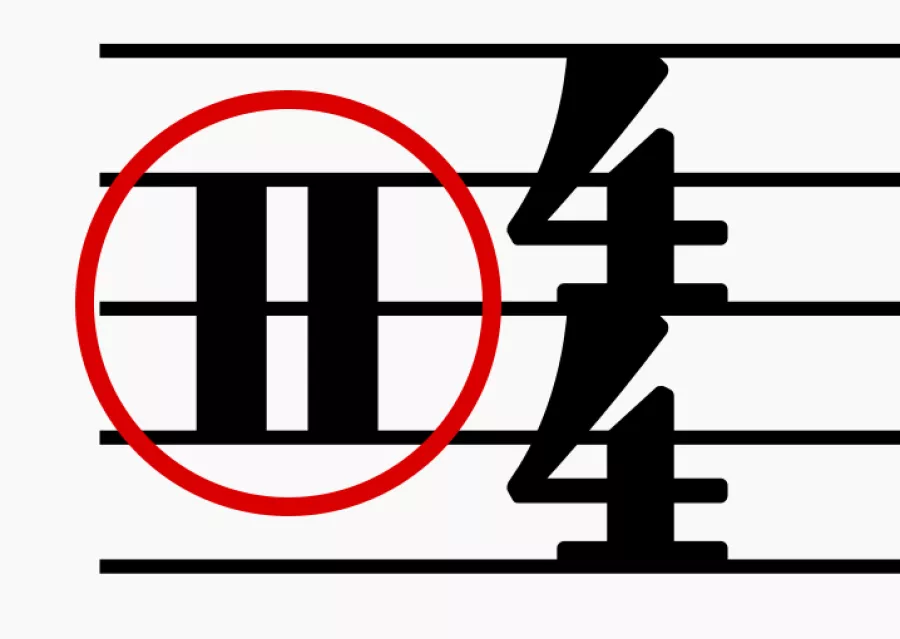
Take a look at the very beginning of the line. Instead of a treble or bass clef, you often see two thick, vertical bars in drum music.
This is the neutral clef (or percussion clef). It signals: “Attention, there are no fixed pitches here, but percussion instruments”.
Understanding Rhythm: Your Mathematical Grid
The good news: the note values (whole, half, quarter, eighth) that apply in general music theory work exactly the same for the drums. The difference lies in the application: as a drummer, you are the engine of the band. You have to hold the grid.
The quarter notes are often your pulse (e.g., played on the hi-hat or ride). You count: “1, 2, 3, 4”.
The eighth notes fill this pulse with life. You count: “1 and 2 and 3 and 4 and”.
While a pianist holds a note until the key is released, a hit on the snare is short and percussive. In drum notation, the note length primarily indicates when the next hit comes.
The Map of Your Drum Kit (The Legend)
Since every drum kit is set up differently (more toms, diverse cymbals), there are small differences in notation. However, the most common symbols you need to know for how to read drum sheet music are almost always the same. This is the most important mnemonic for beginners:
Round noteheads (●): Everything with a skin stretched over it (Snare, Toms, Bass Drum).
X-heads (✖): Everything made of metal (Hi-Hat, Crash, Ride cymbals).
Here is the standard setup:
Bass Drum (Kick): A normal notehead right at the bottom (usually in the bottom space or on the bottom line).
Snare Drum: A normal notehead right in the middle (often in the third space from the bottom).
Hi-Hat: Here the head changes! Cymbals are usually represented with an “x” instead of a round dot. The hi-hat usually sits right at the top on the fifth line.
Crash/Ride Cymbal: Also an “x”, often noted even higher than the hi-hat or on a ledger line.
Pro Tip: If you have a sheet of music in front of you, look for the Legend at the start first. It is your dictionary for that specific piece.
Your Ticket to the World of Pros
Knowing how to read drum sheet music is not dry theory, but your ticket to better communication and creative freedom. You can record your ideas, learn songs faster, and finally understand what the bassist wants from you. Start with the basics: Bass Drum, Snare, and Hi-Hat. The rest comes with the groove!
Frequently Asked Questions About Reading Drum Music
Why do cymbals have an “x” as a notehead?
This is for a better overview. It allows you to recognise at a glance: “Aha, that’s metal (cymbal)” and prevents you from confusing it with a drum (skin), which usually has round heads.
Is playing drums from sheet music harder than piano?
It is different. You don’t have to read harmonies or melodies. However, the rhythmic complexity and the coordination of four limbs are often more demanding. Reading itself is generally considered easier to learn.
Do I need sheet music if I only want to play rock?
It helps enormously. At the latest when you want to write your own songs or play cover songs exactly note-for-note, you save hours of time because you don’t have to work everything out by ear.
What is the best way to practise difficult rhythms?
Break the rhythm down. Practise just the hands first, then add the feet. Definitely use a metronome or the practice mode in your app to set the tempo extremely slow at first and then increase it step by step.
Why does drum sheet music look different in different books?
Unfortunately, there is no 100% uniform regulation for drum notation, as drum kits can be configured very individually. It is therefore important to always look at the Legend (the “Drum Key”) at the beginning of a piece first, to know which symbol is assigned to which instrument.
Do you finally want to understand what lies behind those black dots on the lines? Whether you’re sitting at the piano, holding a guitar, or grooving on the drums – in this guide, we decode the secrets of music notation for you. Simple, easy to understand, and suitable for every instrument. Learn to speak the universal language of music and unleash your full potential!