Do you finally want to understand what lies behind those black dots on the lines? Whether you’re sitting at the piano, holding a guitar, or grooving on the drums – in this guide, we decode the secrets of music notation for you. Simple, easy to understand, and suitable for every instrument. Learn to speak the universal language of music and unleash your full potential!
Fundamentally: Sheet music is the universal written language of music. It shows you precisely which note (pitch) to play and for how long (rhythm).
Important: Every instrument has its quirks, but the basics of the stave, note values, and rhythm are the same for almost everyone.
Tip: Start with the basics and learn step-by-step. Instead of wanting to do everything at once, concentrate on small, regular practice sessions – this brings the greatest success.
Why Learn How to Read Sheet Music at All?
In a world full of YouTube tutorials, tabs, and chord apps, many beginners ask themselves: Do I really need this? The clear answer is: Yes, if you want to become a truly confident musician! Learning how to read sheet music isn’t a chore, but your key to musical freedom and a deep understanding.
The advantages at a glance:
Universal Communication: Sheet music is the global language of music. You can easily play with musicians who have mastered other instruments.
Infinite Library of Music: The entire literature of music is open to you – from classical masterpieces to modern jazz standards.
Precision and Expression: Sheet music conveys much more than just the sequence of tones. It gives you exact information about rhythm, tempo, dynamics, and playing style.
Improved Ear: Reading notes trains the connection between what you see and what you hear. Your musical ear will improve enormously as a result.
Learn Guitar & Piano with music2me!
Whether you want to strum your first guitar chord or play your favourite piano piece fluently – with music2me, you’ll learn your instrument at your own pace. Our proven system truly helps you progress, whether you’re a beginner or an advanced player.
Over 400 video lessons & downloadable sheet music
Interactive tools like Skill Check & smart practice mode
Weekly live classes & personal teacher support
Exclusive Discord community for motivation & exchange
Before we look at individual instruments, let's clarify the building blocks that are the same for everyone. View it as the alphabet and grammar of music.
The Stave (The Staff)
The basis is formed by the stave, consisting of five horizontal lines and four spaces. The rule is simple: The higher the note is positioned on the stave, the higher the pitch. The notes can sit on a line or in a space. If the five lines aren't enough (for very high or low notes), small additional lines are used, known as ledger lines.
The Clefs: Your Reference Point
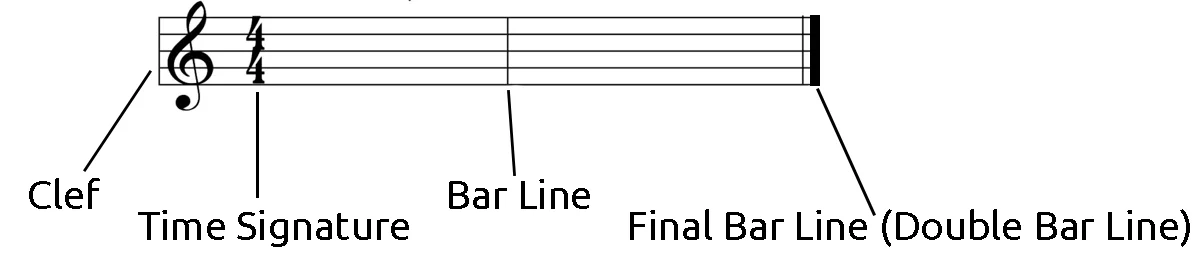
At the beginning of every line of music stands a clef. It establishes a reference note, from which all other notes are derived. The two most important ones are:
The Treble Clef (G Clef): It curls around the second line from the bottom and establishes that the note "G" sits here. It is used for high-pitched instruments and the right hand on the piano.
The Bass Clef (F Clef): Its two dots frame the fourth line from the bottom, defining it as the note "F". It is used for low-pitched instruments and the left hand on the piano.
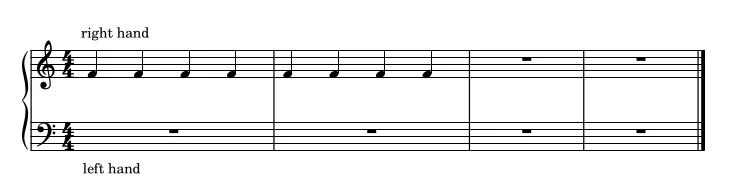
Info: On the far left, you will often find a curly bracket, known as a brace. It connects two staves, one for the right and one for the left hand – typical for instruments like the piano.
Pitch and Note Names: From C to B
The fundamental notes, the natural notes, are named C, D, E, F, G, A, B. They repeat in different octaves. To remember which note lies on which line in the Treble Clef, these memory aids help:
Notes…
Names
memory aids
…on the lines
E - G - B - D - F
Every Good Boy Deserves Football
…in the spaces
F - A - C - E
Spells the English word: FACE
The tones in between are represented by accidentals:
A Sharp (♯) raises a note by a semitone (e.g., C becomes C sharp).
A Flat (♭) lowers a note by a semitone (e.g., B becomes B flat).
Rhythm, Note Values, and Time Signature
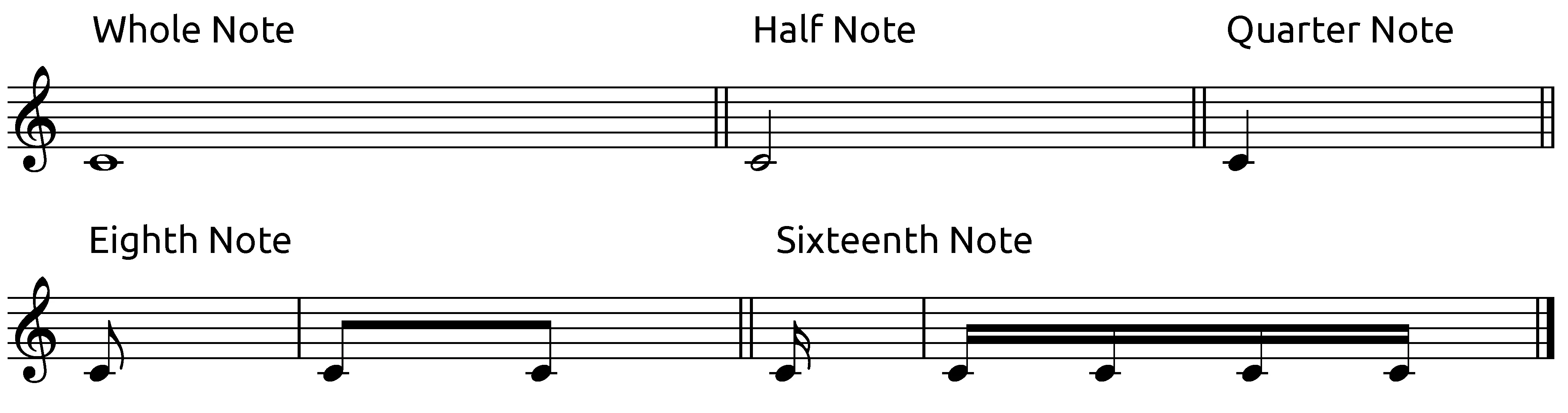
While the height of the note determines the pitch, its appearance (the note value) tells you how long you must play it. The whole thing is organised by the time signature (e.g., 4/4 time). Just as important as the notes is the silence: For every note value, there is a corresponding rest symbol.
Whole Note: Lasts 4 beats.
Half Note: Lasts 2 beats.
Quarter Note: Lasts 1 beat.
Eighth Note: Lasts half a beat.
Sixteenth Note: Lasts a quarter of a beat.
When several eighth or sixteenth notes follow one another, their flags are often connected into a continuous beam – this makes reading the rhythm easier.
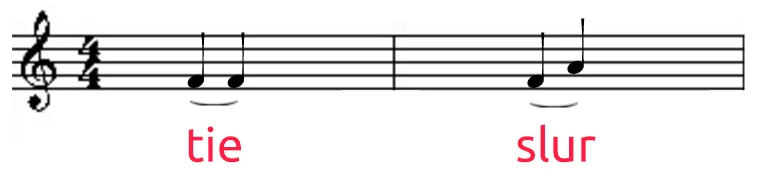
There are also ties and slurs (curved lines) that help you to play two notes together or to hold a note longer.
The Tie: The tie tells you that you should play two notes of the same pitch as one connected sound. For example, if you see two quarter notes tied together, you play these as one single note lasting 2 beats.
The Slur: The slur connects two notes of different pitches. You play these two tones without a break (legato).
Reading Sheet Music for Guitar: The Challenge of Possibilities
For guitarists, switching from tabs to standard notation is often an adjustment, because here there is a crucial peculiarity: One and the same note can be played in several places on the fretboard. You can find a 'C' on the B-string at the 1st fret, but also on the G-string at the 5th fret.
Learn in Positions: Concentrate initially only on the first position (frets 1 to 4). Learn systematically which note lies on which string in this area.
The Open Strings as Anchors: Memorise the notes of the six open strings (E-A-D-G-B-e) and their position in the treble clef thoroughly. They are your foundation.
Practise Systematically: Tackle one string per week. Play simple melodies only on this one string to solidify the connection between note, fret, and sound.
Learning guitar with standard notation requires a bit more mental transfer at the beginning but rewards you with incredible flexibility in your fingering.
Reading Sheet Music for Piano: The Logical Connection
The piano is often the ideal instrument to learn how to read sheet music, because here the connection between the notation and the keys is particularly clear and direct. For the piano, you read from the so-called grand staff (two staves joined by a brace), which combines the treble clef for the right hand and the bass clef for the left hand.
The specifics for the piano:
Clear Assignment: Every note on the sheet corresponds exactly to one single key on the keyboard. There is no confusion about where a note must be played.
Middle C as a Bridge: Exactly between the two staves lies Middle C, your most important orientation point connecting both hands.
Visual Logic: The distance between the notes on the sheet often corresponds to the distance on the keys. A third (e.g., from C to E) means skipping "one line/space" on the stave and skipping "one white key" on the keyboard.
The logical structure makes learning piano with sheet music very accessible, especially for beginners. If you want to dive deeper into the topic, take a look at our article on reading sheet music for piano.
Reading Drum Notation: Pure Rhythm
With the drums, everything is different. Here it is not about pitch, but exclusively about rhythm and which part of the drum kit is played.
The basics of drum notation:
No Pitch: The position of a note on the five lines stands for a specific instrument (e.g., Bass Drum at the very bottom, Snare in the middle, Hi-Hat at the very top).
Neutral Clef: Often a vertical bar, the so-called neutral or percussion clef, is used.
Different Note Heads: A normal round note head usually stands for a drum (Snare, Tom). An "x" typically stands for a cymbal (Hi-Hat, Ride).
No Uniform Standard: There are different ways of writing this. Therefore, you will often find a legend (key) at the beginning of a piece explaining which symbol stands for which instrument.
Daily Mini-Sessions: Better 10 minutes a day than one hour a week. Consistency beats intensity!
Start with Simple Songs: Children’s songs or simple folk songs are perfect for applying what you’ve learned musically right away.
Use a Learning App: A structured course like the one at music2me guides you step-by-step through music theory. Interactive exercises and direct feedback help you stay on track and correct mistakes immediately.
Why an App is Your Best Sheet Music Teacher
Of course, you can learn notes from books. But digital tools offer decisive advantages that not only speed up your learning process but also make it much more flexible:
Set Your Own Pace: You are not bound by rigid appointments. You decide for yourself how fast you progress, and you can repeat lessons as often as you like until you feel confident.
Theory Meets Practice: Dry theory is often abstract and boring. With music2me, you learn a theoretical concept and apply it immediately in a real song. This mix of music theory and practice helps you internalise what you've learned directly and keep the fun in playing.
Additional Material: Want to practise offline sometimes? No problem. Professional sheet music and fingerings are available to print out for the lessons, so you remain flexible at all times.
Understanding Music, Not Just Replaying It
Learning how to read sheet music is one of the most rewarding investments in your musical future. It opens doors that would otherwise remain closed to you, and transforms you from someone who plays an instrument into a real musician who understands and speaks the language of music. Dare to take the first step – it is easier than you think!
Frequently Asked Questions About Reading Sheet Music
What is the easiest instrument to learn how to read sheet music on?
Many find the piano the easiest, as every note is assigned to a fixed key. However, the basics of notation are the same for all instruments.
Do I need to be able to read music as a drummer?
It is extremely helpful for learning complex rhythms, noting down ideas, and being able to communicate professionally with other musicians.
How long does it take until I can sight-read notes fluently?
That depends on your practice routine. With 10-15 minutes of daily practice, you can read simple pieces confidently on most instruments within a few months.
Is there a difference between sheet music for guitar and bass?
Yes, mainly the clef. While the guitar is notated in the treble clef, the bass (like the left hand of the piano) uses the bass clef for its low tones.
Can an app really help me learn how to read sheet music?
Absolutely. Modern apps like music2me offer structured courses that combine theory and practice. Through interactive exercises and immediate feedback, you often learn faster and with more motivation than with just a book.
Want to learn guitar but don't know where to start? This guide walks you through the first essential steps — perfect for beginners who want to make quick progress.
You'll receive valuable insights on choosing the right guitar, proper playing and posture techniques, and how to read music and tablature. You'll also learn how to play chords, take care of your guitar, and discover the secrets of effective practice to continuously improve your playing. Let's get started!
You want to learn to play the guitar but are unsure which type of lessons suits you – and what the whole thing might cost? In this article, you'll find a comprehensive overview of the various forms of guitar lessons: from music schools and private lessons to online courses. We’ll show you what prices to expect, what factors influence the cost, and how you can learn guitar even on a tight budget.
You want to learn electric guitar and don't know exactly where to start? Don't worry – the beginning is easier than you think. In this guide, we'll show you how to master your first songs with the right equipment, a structured learning plan, and lots of fun in 5 clear and simple steps.
Whether you love rock, pop, metal, or blues, the electric guitar offers you all kinds of sound possibilities. Let’s get started!