From rehearsal room to big stage: the palm mute technique is your ticket to professional‑sounding rock riffs. Ever wondered why the guitars in Metallica, Green Day or Rammstein sound so incredibly tight, precise and massive? A big part of that secret lies in a single, crucial picking‑hand technique.
In this guide, we’ll lift the lid and show you how to get that powerful sound for yourself. Ready to lay the foundation for unforgettable riffs and take your guitar learningto the next level?
In General: Palm muting is a technique where you mute the strings of your guitar with the heel of your picking hand near the bridge. This makes the notes shorter, more percussive and more powerful.
Important: In rock and metal this technique is essential for giving riffs definition and an aggressive character. It keeps every note clear and articulate, even with lots of distortion.
Tip: Experiment with hand position and pressure. Just a few millimetres can change the sound from a soft “thump” to an aggressive “chug”.
What Is the Palm Mute Technique?
Imagine you strike a string and let it ring freely – the sound is long and open. With palm muting you rest the heel of your picking hand lightly on the strings, right where they come out of the bridge.
If you strike the string now, its vibration is immediately “slowed down”. The result:
The note sounds shorter and drier.
It takes on a percussive, almost drum‑like character.
The bass content of the sound is emphasised, making it more powerful and chunky.
How To Learn Palm Muting: Step‑by‑Step
This technique is the be‑all and end‑all of a tight, controlled and powerful guitar sound, especially on electric guitar. Grab your guitar and follow these simple steps — using a pick works best.
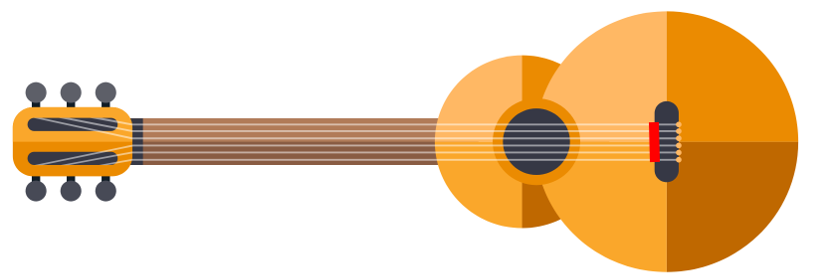
The Right Hand Position: Rest the heel of your picking hand (the hand holding the pick) very gently on the strings, right at the bridge. The edge of your palm should sit exactly where the strings touch the saddles (red).
Gentle Pressure: Apply just a little pressure. You want to stop the strings from ringing out freely, not choke them completely.
The First Stroke: Now pick the low E string. Instead of a clear, ringing note you should hear a short, muted, percussive sound.
Experiment With Position: Move your hand a few millimetres at a time away from the bridge towards the neck, striking the string again each time. You’ll notice: the further you move from the bridge, the duller and shorter the sound becomes, until it eventually disappears.
Find the Sweet Spot: The perfect spot is where you can still clearly hear the pitch, but the note also has that short, percussive character. That sweet spot is what you’re aiming for.
Play a Simple Riff: Try playing a simple rhythm just on the low E string, for example four even downstrokes in a row. Focus on keeping the sound consistent.
Change Strings: Keep your hand where it is and try palm muting on the A and D strings as well. Your hand stays put; only the pick moves across the strings.
You don’t just want to learn the technique but also use it in real songs? Our guitar course at music2me shows you step by step how to master palm muting and other essential rock techniques. Learn from pros and soon you’ll be playing the riffs of your favourite bands.
Learn guitar with music2me!
Do you dream of playing your favourite songs around the campfire or rocking out to the riffs of your heroes? With music2me, you can learn guitar at your own pace – step by step with a system that truly helps you progress, whether you’re a beginner or already advanced.
Over 400 video lessons & downloadable sheet music
Interactive features like our smart practice mode and gamification
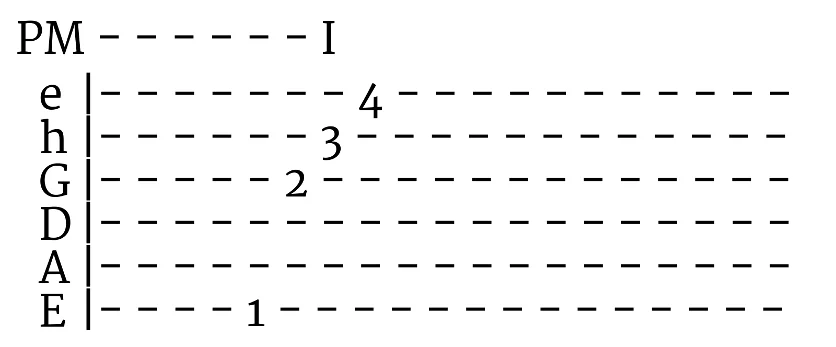
In tablature, palm muting is marked with “P.M.” or “PM”. A dashed line afterwards shows how long the notes should be muted. If you see an X in the tab without any P.M. marking, it usually means you should mute the strings with your fretting hand rather than your picking hand.
5 Famous Rock Songs with Palm Muting: Your First Riffs to Try
Theory is useful, but nothing is more motivating than playing real songs. Here are some iconic rock riffs that rely heavily on the palm mute technique:
Metallica – “Enter Sandman”: The legendary clean intro riff switches between muted and open notes – a perfect exercise in control.
Nirvana – “Smells Like Teen Spirit”: The intro riff uses just a few chords, but palm muting gives them that dirty yet defined grunge sound.
Green Day – “Basket Case”: A textbook example of fast punk rock. Power chords with constant, rapid palm‑muted strokes create the driving rhythm.
Rammstein – “Du Hast”: The epitome of a brutal, rhythmic riff. Low‑tuned guitars and relentless palm muting on the lowest string create a wall of sound.
AC/DC – “Back in Black”: Angus Young is a master of dynamics. Many of his riffs live from the contrast between hard‑struck open chords and tightly muted notes.
Your Sound, Your Rules: How to Refine the Technique
Once you’ve got the basics down, the real fun begins. Palm muting isn’t an exact science; it’s a tool for expression.
Play With Dynamics: Switch within a riff between heavily muted and almost open notes. This creates tension and brings your playing to life.
Use Distortion: An overdrive or distortion pedal highlights the percussive side of palm muting even more. This is where the technique shows its full rock potential.
Combine It With Open Chords: Play a verse with palm mutes ...and let the chorus explode with big, ringing power chords. This contrast is one of the most powerful tools in rock.
Learn over 70 rock songs and riffs with music2me!
Ever dreamed of playing the songs of your heroes? Our "rock songs & riffs"module is your gateway into the world of rock guitar. From timeless rock anthems and grunge classics to modern riffs, our easy-to-follow video lessons show you how to truly rock using essential techniques like bending and slides.
Common Beginner Mistakes with Palm Muting (And How To Fix Them)
Everyone starts somewhere, and there are a few classic stumbling blocks with this technique. Here’s how to avoid them:
Too Much Pressure
Problem: The note is completely dead and you only hear a “click”.
Solution: Rest your hand really lightly. Imagine you’re brushing a fly off the string rather than squashing it.
Wrong Hand Position (Too Far From the Bridge)
Problem: The note loses definition and sounds muddy.
Solution: Always start right at the bridge and work forwards slowly. The best sound almost always comes from a zone about 1–2 cm from the bridge.
The Hand Moves Around While You Play
Problem: The sound is inconsistent. Some notes are very muted, others almost open.
Solution: Your palm is the anchor. It stays where it is; only your wrist and fingers move the pick.
One Sound, Many Faces: The Role of Palm Muting in Rock and Beyond
Palm muting is a versatile guitar technique used in countless genres and a big part of their sound. In metal, especially in heavy metal, thrash, death and black metal, palm muting is essential to shaping the aggressive, powerful tone of these styles.
But the technique is by no means limited to the heavier end of the spectrum. In many rock sub‑genres, pop and indie, guitarists use palm muting to make riffs and chords more interesting. Punk bands also rely on it to shape their energetic sound. Palm muting is particularly flexible on electric bass, where it appears in genres such as soul, reggae and blues, and even in more modern styles like R&B, neo soul, hip‑hop and gospelto create tight, almost synthetic‑sounding lines.
Thanks to its flexibility and expressive power, palm muting is a valuable technique for musicians in many different genres. But especially in rock and metal, where you often play with a distorted sound, it really shows its superpower. Without muting, the result would quickly turn into a muddy, indistinct mess. Palm muting cleans up the sound: each note is stopped precisely before the next one starts. That creates the typical aggressive “chugga‑chugga” sound which, together with power chords, forms the rhythmic backbone of almost every great rock anthem.
Now You’re Ready for the Big Stage
Palm muting is far more than just “damping notes”. It’s the rhythmic foundation that brings riffs to life and gives your guitar playing the power and precision needed for a rock sound. It’s a skill that helps you move from beginner to confident rock guitarist. Be patient at the start, pay attention to the details, and above all: listen closely to your favourite songs. You’ll start to spot palm muting everywhere. Then pick up your guitar, turn up the amp and get going. The stage is waiting.
Frequently Asked Questions About the Palm Mute Technique
Can I use palm muting on an acoustic guitar too?
Yes, absolutely. The effect is more subtle than on a distorted electric guitar, but it works the same way. It gives your acoustic playing a warm, percussive and more intimate character - ideal for singer‑songwriter styles.
Which pick is best for palm muting?
Many rock and metal guitarists prefer thicker, stiffer picks (around 1.0 mm or more). They allow for a more precise, powerful attack, which gives the muted sound more bite.
How do I recognise palm muting in notation or tabs?
In tablature, palm muting is usually marked with the letters “P.M.” above the notes. A dashed line often shows how long the notes should be muted.
Do I always have to use only downstrokes when palm muting?
No, but for beginners it’s the easiest way to get a steady, consistent rhythm. More advanced players also use alternate picking to play faster and more complex riffs.
My sound is still muddy even with palm muting. Why?
Check your amp settings. Too much bass or too much gain can make the sound muddy, even with good technique. Try rolling back the bass a little and avoid turning the gain all the way up.
Want to learn guitar but don't know where to start? This guide walks you through the first essential steps — perfect for beginners who want to make quick progress.
You'll receive valuable insights on choosing the right guitar, proper playing and posture techniques, and how to read music and tablature. You'll also learn how to play chords, take care of your guitar, and discover the secrets of effective practice to continuously improve your playing. Let's get started!
You want to learn to play the guitar but are unsure which type of lessons suits you – and what the whole thing might cost? In this article, you'll find a comprehensive overview of the various forms of guitar lessons: from music schools and private lessons to online courses. We’ll show you what prices to expect, what factors influence the cost, and how you can learn guitar even on a tight budget.
You want to learn electric guitar and don't know exactly where to start? Don't worry – the beginning is easier than you think. In this guide, we'll show you how to master your first songs with the right equipment, a structured learning plan, and lots of fun in 5 clear and simple steps.
Whether you love rock, pop, metal, or blues, the electric guitar offers you all kinds of sound possibilities. Let’s get started!