Choosing the right guitar size is one of the most important decisions you can make when starting out. Whether it’s a steel-string acoustic, classical, or electric guitar – the size of the guitar determines how comfortably you can play, how quickly you make progress, and whether the instrument truly fits you – or your child.
In this article, we’ll look at the different guitar sizes, compare sizes for children and adults, and give you clear recommendations based on age and height. We’ll also reveal professional methods like the "Elbow Test" to help you avoid making the wrong purchase.
Basically: It’s not age, but height and arm length that are decisive for choosing the right guitar.
Important: A guitar that is too large often leads to poor posture, tension, and can quickly drain a beginner's motivation.
Tip: For smaller adults or teenagers, a 7/8 guitar is often the perfect compromise between playing comfort and full sound.
Do you already have a guitar in mind or perhaps own one? Perfect! Before we dive deep into the measurements, here is the most important starting point for your journey on the instrument: Our guide for learning guitar in 10 steps shows you exactly how to get started.
Learn guitar with music2me!
Do you dream of playing your favourite songs around the campfire or rocking out to the riffs of your heroes? With music2me, you can learn guitar at your own pace – step by step with a system that truly helps you progress, whether you’re a beginner or already advanced.
Over 400 video lessons & downloadable sheet music
Interactive tools like Skill Check & smart practice mode
Weekly live classes & personal teacher support
Exclusive Discord community for motivation & exchange
When thinking of guitars, many people first think of sound, wood, design, or price. But the size of the instrument is just as crucial – if not more so. If the instrument doesn’t fit the body, technique suffers.
This happens with a guitar that is too large:
The fretting hand has to stretch unnaturally.
The shoulder is pulled up and becomes tense.
The fingers don’t reach the frets cleanly, leading to buzzing notes.
The fun of practising is lost.
This happens with a guitar that is too small:
The fingers are too crowded (especially for adults).
Your sitting posture becomes hunched.
The sound can seem a bit thinner, especially with very cheap models.
Beginners, in particular, need an instrument that feels good. If you can position your fingers comfortably and keep your hand relaxed, you will automatically learn faster and play more cleanly. This keeps your motivation high – a point that is very important right at the start of playing the guitar.
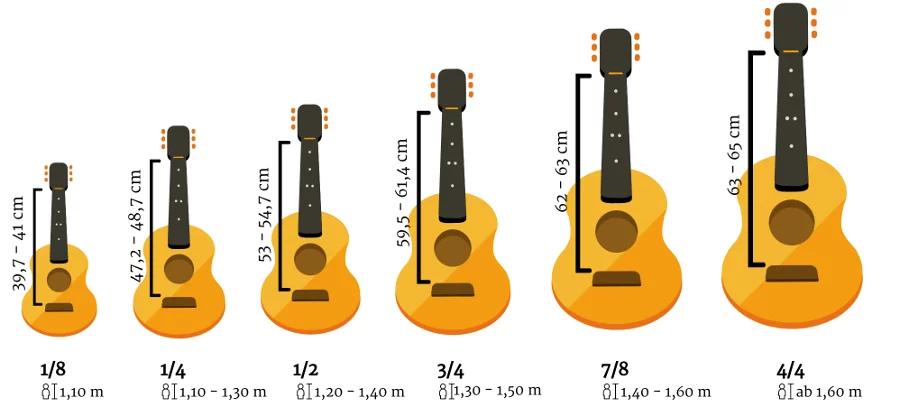
The Most Important Guitar Sizes at a Glance (Acoustic Guitars)
Important: This table serves as a guideline. Since children grow at different rates, body height is always a more important indicator than age alone.
Differences with Acoustic and Electric Guitars
Acoustic guitars and electric guitars are not typically categorized in fractional sizes. Here, you look more at the scale length or the body volume.
Acoustic Guitar (Steel String)
Children's sizes are rare for steel-string acoustics. Instead, you select based on body shape:
Standard scale length: approx. 64–65 cm
"Dreadnought": A Dreadnought has a massive sound, but also a large body and is more suitable for adults.
"OM (Orchestra Model)", "Concert" or "Auditorium": These body shapes have a smaller body and a narrower waist. They are often more comfortable for smaller people but usually still have a normal scale length.
Electric Guitars
Electric guitars are generally smaller and lighter because they don’t have a resonance body. The scale length varies between 62 cm (Gibson style) and 65 cm (Fender style). Many teenage beginners get along well with standard sizes because the body is flat and comfortable.
This test is particularly practical in a music shop:
Place the guitar on the floor with the headstock pointing up (or hold it vertically).
Rest your elbow loosely on the body (side/bout) directly next to the heel of the neck.
Your forearm should point upwards parallel to the guitar neck.
The result: Your knuckles (wrist base) should now be roughly between the 1st and 2nd fret. If the hand is much lower, the guitar is too small. If it is higher, it is too big.
Rule of Thumb for Calculating Scale Length
You can also roughly calculate the suitable scale length (length of the vibrating string):
Formula: Height (in cm) x 0.36 = ideal scale length.
Example: You are 165 cm tall. 165 x 0.36 = 59.4 cm. Here, a 3/4 or 7/8 guitar (scale length approx. 58-62 cm) would likely be a very good fit.
The Role of Scale Length
The scale length is the vibrating string length, i.e., the distance from the nut to the bridge. A short scale length means lower string tension, making it easier to fret. A long scale length has tighter tension and a brighter sound but is harder to fret. Many beginners notice the difference immediately: The fretting hand and fingers tire faster with longer scale lengths.
Important Note for Parents: Don't Buy “To Grow Into”!
Many parents know this from clothes: "The child will grow into it." With instruments, unfortunately, this is a mistake. If your child is supposed to learn to play now, the guitar must fit now. A guitar that is too large forces the child into an unnatural posture. The result: The little finger doesn’t reach the strings, notes buzz, and motivation drops to zero. A fitting, affordable entry-level guitar is better than an expensive one that won't fit for another two years.
Why Some Adults Choose a Smaller Guitar
A 4/4 guitar doesn’t necessarily have to be the right instrument for all adults; there are exceptions:
Reasons for a Smaller Guitar:
Smaller hands
Shoulder or back problems
Ideal for travel
Easier fretting due to the shorter scale length
The 7/8 guitar, in particular, is ideal for anyone looking for a compromise between full sound quality and comfortable playability.
Guitar Size and Playing Style
Depending on what you want to play, the style can also influence your choice.
Classical / Fingerstyle: More compact guitars are often better suited for longer practice sessions, especially for smaller hands.
Singer/Songwriter: A Dreadnought is the classic singer/songwriter guitar. It sounds warm, balanced, and voluminous, but also has a large body.
Rock / Electric Guitar:Standard sizes fit almost always, but short-scale guitars (e.g., Fender Mustang or Jaguar models) are very popular for small hands.
Mini Guitar vs. Travel Guitar vs. 3/4 Guitar
These are often confused:
Mini Guitars: Very small, for on the go or as a "fun" instrument.
Travel Guitars: Reduced body size, but normal scale length.
3/4 Guitar: A true child size, suitable for serious learning.
If you are looking for a full-fledged learning instrument, always choose a classic 3/4 or 7/8 size, not a mini guitar.
6 Tips for Trying Out in the Music Shop
Sit down – the guitar should rest calmly on your leg.
Fret at the first fret – if you have to stretch, it’s too big.
Play with four fingers over the first four frets across all strings.
Play the chords G–C–D – if you can manage them without cramping, the size fits.
Test several sizes – comfort decides, not the numbers.
Listen to your body – pain or tension is a sign that something is wrong.
Your Start with the Right Guitar
Have you found your suitable size? Brilliant! Then nothing stands in the way of your success. The important thing is: The guitar must feel good. If you stay relaxed while playing and can reach all areas well, you will make faster progress and have more fun. Test different sizes, rely on how it feels — not just on tables or specifications. Then you will definitely find your perfect instrument.
The right instrument is the foundation – but the right teacher builds the house upon it. At music2me, we accompany you step by step. In our guitar course, you will not only learn the correct posture (matching your guitar size) but will also be playing your first songs in no time.
Frequently Asked Questions About Guitar Size
Which guitar size is suitable for adults?
Mostly the 4/4 size (Standard). However, many adults (especially under 1.65 m) feel significantly more comfortable on a 7/8 guitar or a steel-string acoustic with a smaller body (000-shape or Parlor).
Can I play a 3/4 guitar as an adult?
Yes, absolutely. Ed Sheeran, for example, often plays very small guitars. A 3/4 guitar is handier and is excellent as a travel guitar. You just have to bear in mind that the frets are closer together.
What size does an 8-year-old child need?
That depends on their height. Usually, a 3/4 guitar fits best for a height of 130–150 cm. If the child is smaller, the 1/2 guitar is the better choice.
Can a guitar that is too big be harmful?
Yes, definitely. Permanently incorrect posture often leads to tension in the neck, shoulder, and back area. Wrist pain is also typical because you have to stretch unnaturally to reach the frets. This not only massively slows down your learning progress but can lead to serious postural damage in the long run.
Do electric guitar sizes differ as much as classical guitars?
No, electric guitars usually have standard sizes (scale length approx. 62–65 cm). However, since the body is flatter and smaller than with acoustic guitars, teenagers usually get along well with standard models too. For very small hands, there are "short-scale" models.
Want to learn guitar but don't know where to start? This guide walks you through the first essential steps — perfect for beginners who want to make quick progress.
You'll receive valuable insights on choosing the right guitar, proper playing and posture techniques, and how to read music and tablature. You'll also learn how to play chords, take care of your guitar, and discover the secrets of effective practice to continuously improve your playing. Let's get started!
You want to learn to play the guitar but are unsure which type of lessons suits you – and what the whole thing might cost? In this article, you'll find a comprehensive overview of the various forms of guitar lessons: from music schools and private lessons to online courses. We’ll show you what prices to expect, what factors influence the cost, and how you can learn guitar even on a tight budget.
You want to learn electric guitar and don't know exactly where to start? Don't worry – the beginning is easier than you think. In this guide, we'll show you how to master your first songs with the right equipment, a structured learning plan, and lots of fun in 5 clear and simple steps.
Whether you love rock, pop, metal, or blues, the electric guitar offers you all kinds of sound possibilities. Let’s get started!