Do you know the feeling of hearing a song and wondering why the chords fit together so perfectly? Or you’re sitting at the piano or holding a guitar and you spend ages searching for the next chord that works with your melody? The solution is simpler than you think – and it’s one of the most powerful tools in music theory: the Circle of Fifths. It’s your personal compass in the world of harmony.
This article decodes the Circle of Fifths for you – without complicated jargon. We’ll show you how it’s built, how to read it, and most importantly, how to use it to find chords faster, understand songs, and get creative yourself.
No time to scroll? Find your topic instantly:
The Essentials of the Circle of Fifths at a Glance
In general: The Circle of Fifths is a graphic representation of all 12 major and minor keys, arranged in intervals of a perfect fifth. At a glance, it shows which keys and chords are harmonically related.
Important: With the Circle of Fifths, you can determine how many accidentals (♭ or ♯) a key has, find suitable chords for a song, and understand the relationship between major keys and their relative minor keys.
Tip: Don’t think of the Circle as a strict rule – think of it as a map. Chords next to each other on the circle usually sound good together.
What Is the Circle of Fifths – and Why Is It Your Best Friend?
Imagine you’re trying to play a song by ear. You’ve got the first chord – maybe C major – but what comes next? G major? A minor? F major? Instead of guessing randomly, you can look at the Circle of Fifths and instantly see which chords are the most likely candidates.
That’s its superpower: it makes harmonic relationships visible. At its core, the Circle of Fifths is basically a clock – except instead of numbers, you see the 12 tones of our Western music system.
The distance from one “hour mark” to the next is always a perfect fifth (seven semitones). If you start on C major and move clockwise, you land on G, then D, and so on.
How to Read the Circle of Fifths: Decoding Accidentals and Relative Keys
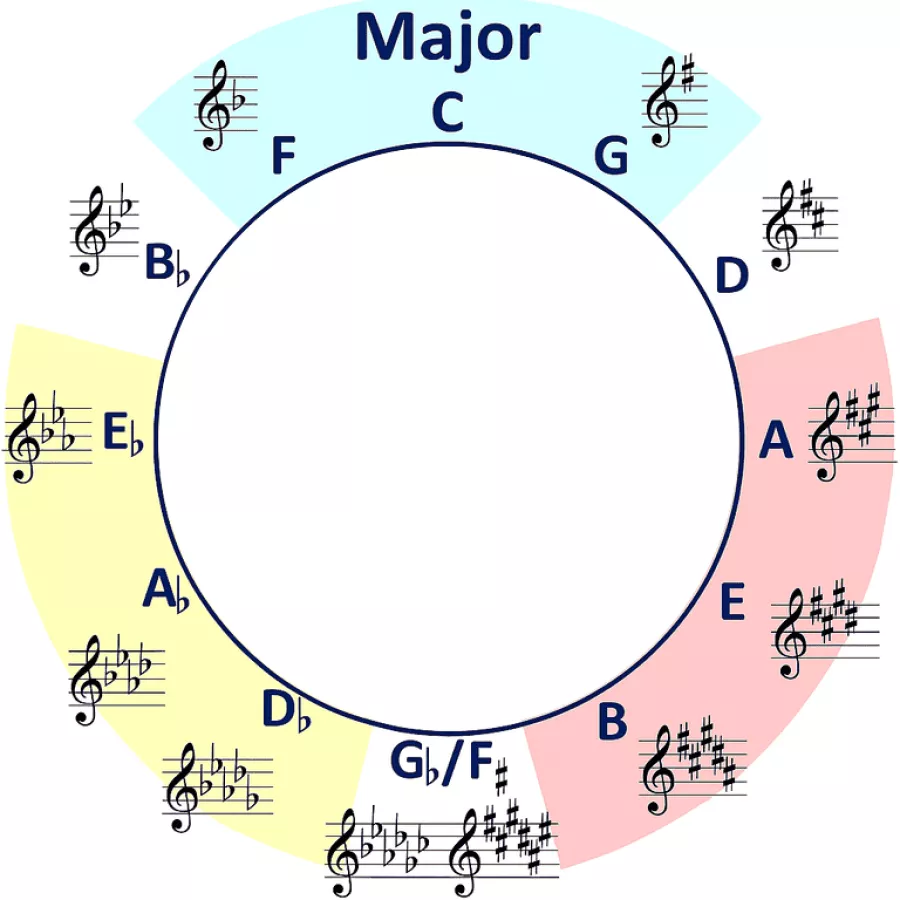
The brilliant thing about the Circle of Fifths is that it doesn’t just show you keys – it also shows how many and which accidentals (sharps ♯ or flats ♭) each key has.
Sharp Keys and Flat Keys
The rule is simple:
Clockwise (to the right): Each step from C major adds one sharp (♯). G major has 1 ♯, D major has 2 ♯, A major has 3 ♯, and so on.
Counterclockwise (to the left): Each step from C major adds one flat (♭). F major has 1 ♭, B♭ major has 2 ♭, E♭ major has 3 ♭, and so on.
to view this content.
Where Do Accidentals Come From? A Look at Tetrachords
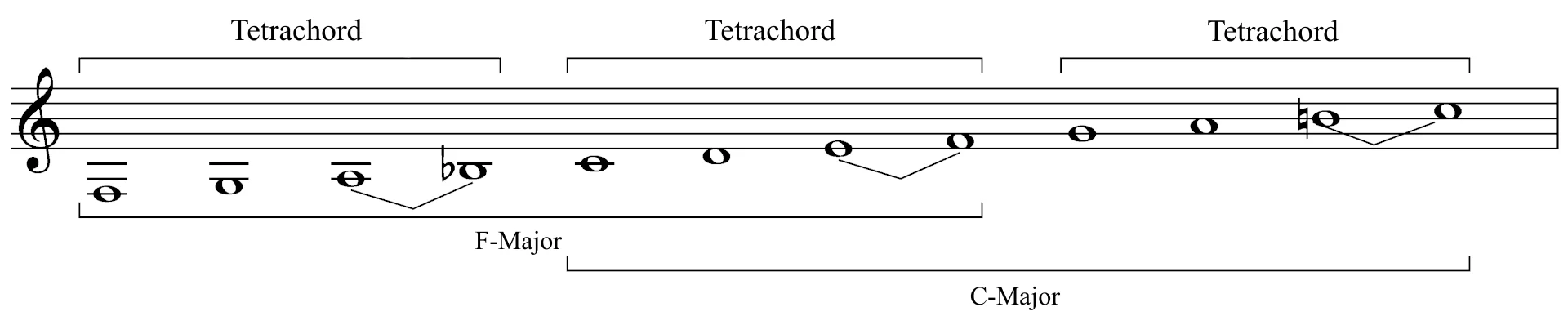
Have you ever wondered why G major has exactly one F♯? The answer lies in how the major scale is built: it consists of two identical building blocks called tetrachords (four-note groups). Their step pattern is always: whole step – whole step – half step.
f we build a new scale starting on the fifth note (G), the second tetrachord of C major becomes the first tetrachord of G major. To keep the correct step pattern, the seventh note must be raised – F becomes F♯.
The same principle works in reverse for flat keys.
Relative Minor Keys in the Inner Circle
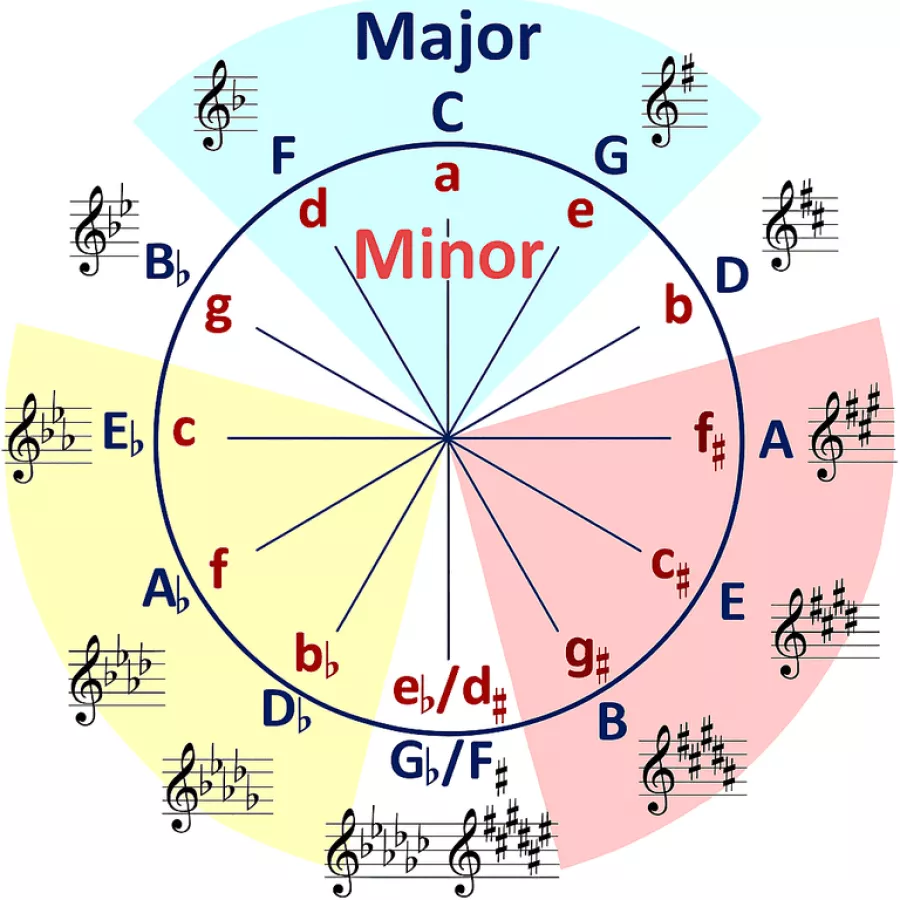
In the inner circle, you’ll find the relative minor keys. Every major key has a minor key that uses the exact same accidentals.
For example, C major has no accidentals – just like A minor. That’s why A minor is the relative minor of C major.
Rule of thumb: You’ll always find the relative minor a minor third (three semitones) below the major key.
Two mnemonics that will help you forever
To remember the order of keys, there are two classic mnemonics:
For sharp keys (clockwise): “Go Down And Eat Hot Fudge.”
For flat keys (counterclockwise): “Fat Boys Eat Apple Dumplings Greedily."
Using the Circle of Fifths on Guitar and Piano: Two Instruments, One System
Even though the Circle of Fifths is universal, you’ll apply it a bit differently on guitar and piano. On both instruments, it helps you visualise the logic behind harmony.
The Circle of Fifths on Guitar: The Power of Patterns
On guitar, it’s less about counting keys and more about visual patterns and shapes.
Movable shapes: A big advantage of guitar is that chord shapes (e.g., barre chords) are movable. The Circle of Fifths helps you understand where to move them. An F major barre chord at the 1st fret becomes a G major barre chord at the 3rd fret. This shows how easily chord shapes can be moved on the guitar. The Circle of Fifths then helps you understand which of these chords are harmonically related — for example, why C, F and G work so well together.
The CAGED system: While CAGED is not the same as the Circle of Fifths, both systems help you understand the fretboard in patterns. CAGED shows you how chord shapes connect across the neck, while the Circle of Fifths explains how those chords relate harmonically.
Finding dominants: The dominant (the chord a fifth above) often sits in a very logical spot on the fretboard. From a root note on the low E or A string, you can often find the dominant’s root one string lower and two frets higher.
The Circle of Fifths on Piano: Keyboard Logic
On piano, the Circle of Fifths becomes a direct visual map of the keyboard.
Understanding accidentals: The piano’s strength is its linear layout. When you move from C major (all white keys) to G major (a fifth higher), you immediately see the change: exactly one black key appears (F♯). The Circle of Fifths explains why that happens and which note comes next.
Feeling harmonic closeness: Neighbouring keys on the circle share most notes. Moving from C major to G major changes only one note (F becomes F♯). That’s why chord changes feel smooth and logical – concepts we also cover in our article on the basics of learning the piano.
Mastering inversions: The circle helps you find the most elegant chord transitions. Instead of jumping from a root-position C major chord (C–E–G) to a root-position G major chord (G–B–D), an inversion lets you stay much closer (e.g., C major to G major in first inversion B–D–G). This makes your playing sound more professional and fluid.
Learn Guitar & Piano with music2me!
Whether you want to strum your first guitar chord or play your favourite piano piece fluently – with music2me, you’ll learn your instrument at your own pace. Our proven system truly helps you progress, whether you’re a beginner or an advanced player.
Over 400 video lessons & downloadable sheet music
Interactive tools like Skill Check & smart practice mode
Weekly live classes & personal teacher support
Exclusive Discord community for motivation & exchange
Practical Use: How the Circle of Fifths Improves Your Music Immediately
Theory is great – but now let’s get practical. Here are four situations where the Circle of Fifths becomes your most important tool.
1. Finding the Right Chords for Any Song
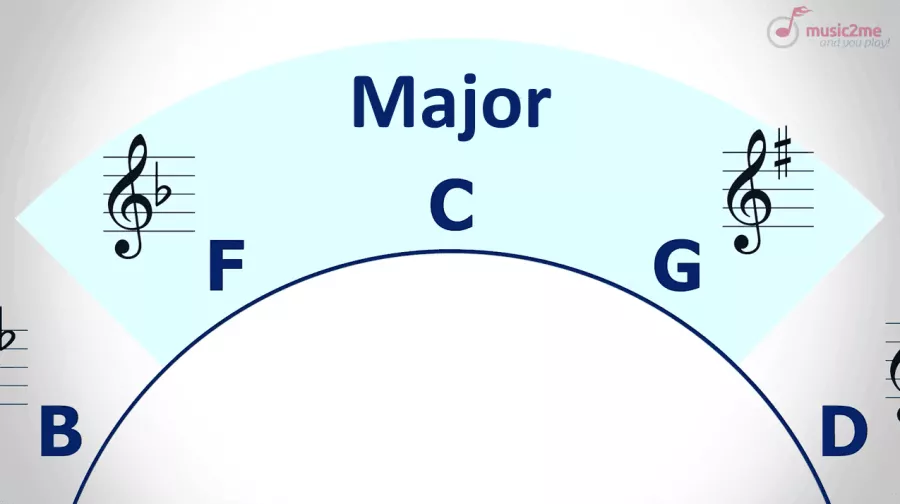
Every key has its own diatonic chords (often called scale-degree chords). The three most important chords in any key (tonic, subdominant, dominant) always sit right next to each other in the Circle of Fifths.
ick a key on the circle (C major).
Subdominant = the chord to the left (F major).
Dominant = the chord to the right (G major).
With these three chords alone, you can already play countless well-known songs. Want more colour? Add the three relative minor chords (Am, Dm, Em) – and you’ve got the six most important chords of the C major scale.
2. Writing and Composing Your Own Songs
For songwriting, the circle helps you build harmonic and interesting chord progressions.
For smooth transitions: Choose chords that are close together on the circle. Moving from C major to G major or F major sounds familiar and pleasant.
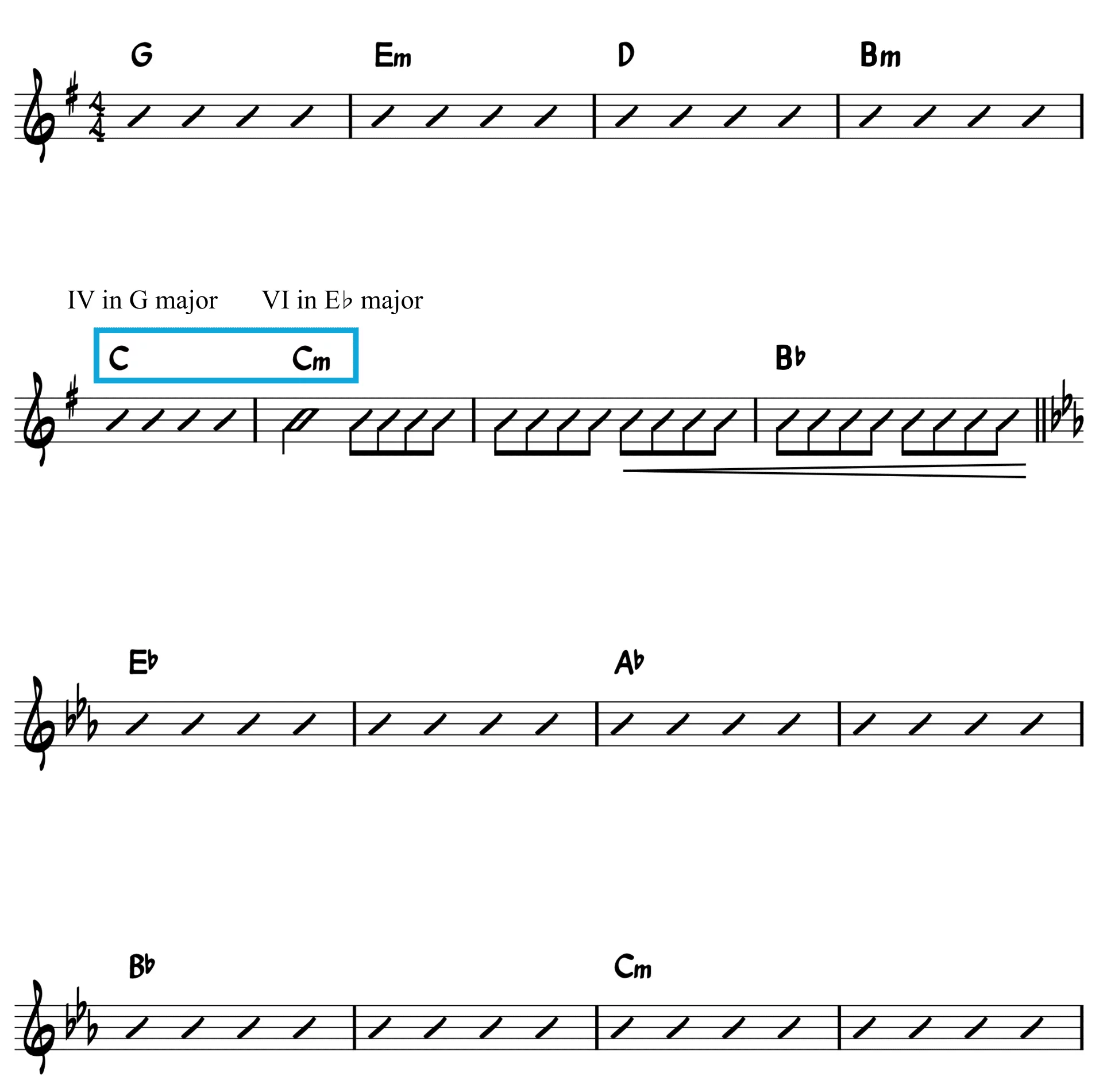
For more tension: Jump to a more distant chord. Imagine your song is in G major and uses typical chords (C, D, Em, etc.). For a solo or bridge you want a big change in colour. Jumping to the opposite side of the circle – e.g., E♭ major – creates that tension. You can use a shared chord like C minor as a pivot to introduce the new key.
3. Analysing and Understanding Music Faster
If you have sheet music, the key signature at the beginning immediately hints at the key. Example:
You see three sharps (♯)? One look at the Circle of Fifths tells you the piece is either in A major or F♯ minor.
Check the first and last chord – most of the time they confirm the home key.
This helps a lot because you instantly know which notes and chords will show up most often – so you can prepare much more efficiently.
4. Improvising Creatively
Improvisation is about choosing notes that fit over a chord progression. The Circle of Fifths shows you the “home base” of your improvisation. If the chords are C major, F major, and G major, you know you can improvise safely and melodically with the C major scale (or the A minor pentatonic).
5. Five Simple Circle of Fifths Exercises
Exercise 1: The three most important chords in a key Pick any key on the Circle of Fifths. The chord in the middle is the tonic, the one on the left is the subdominant, and the one on the right is the dominant. Try this with C, G, D and F major.
Exercise 2: Add the relative minor chords Use the same three major chords and add their relative minors. In C major, that gives you C, F, G, Am, Dm and Em.
Exercise 3: Transpose a simple chord progression Take a progression like C–G–Am–F. Move each chord one step clockwise on the circle and listen to how the new version sounds.
Exercise 4: Practice resolving dominants Play or listen to G major resolving to C major. Then try D to G, A to D and E to A. This trains your ear to hear how strong fifth relationships feel.
Exercise 5: Improvise in a fixed key Choose C major and improvise over the chords C, F and G, using only notes from the C major scale. Once that feels easy, try the same idea in G major.
Your Musical Compass for Every Situation
As you can see, the Circle of Fifths is far more than a dry diagram from music class. It’s a visual shortcut that helps you understand the logic behind music and play with more confidence. Whether you’re learning songs, writing your own music, or just improvising – it’s a reliable companion.
If you want to understand these concepts not only in theory but apply them directly on your instrument, check out our courses at music2me. We’ll guide you step by step through the basics and show you how to turn your new knowledge into real music right away.
Frequently Asked Questions About the Circle of Fifths
What Else Can I Use the Circle of Fifths For?
One practical application is transposing (changing the key of) songs. If a song is too high or too low for you, you can easily shift it to a different key using the circle. If you move the starting chord two steps along the circle of fifths, you simply do the exact same thing with all the other chords in the song.
Why Are There Two Keys in One Box at the Bottom of the Circle?
This is because they sound exactly the same. On the piano keyboard or the guitar fretboard, you play the exact same scale. They are only written differently on sheet music, depending on which direction you approach them from on the circle. Musicians call this an "enharmonic equivalent".
Is There a Difference Between the Circle of Fifths and the Circle of Fourths?
Not really, it’s exactly the same diagram! The name only changes depending on the direction you read it: if you go clockwise, you count in fifths. If you read it counterclockwise, you count in fourths. Wind players and jazz musicians, in particular, often prefer to read this musical "clock" backwards.
Is the Circle of Fifths the Same for Guitar and Piano?
The theory behind the circle of fifths is universal and applies to all instruments. However, the practical application differs: on the piano, the circle mainly helps you to understand the number of accidentals and find smooth chord inversions. On the guitar, it helps you visualise the logic behind movable chord shapes (like barre chords) or the CAGED system across the entire fretboard.
Do I Need to Memorise the Entire Circle of Fifths?
No, definitely not! In the beginning, keeping the circle next to you as a cheat sheet is absolutely fine. Over time, and with regular practice, you’ll automatically memorise the keys. Once you understand the logic behind the system, you can always work out the remaining notes yourself anyway, rather than rigidly learning them by heart.
Want to learn guitar but don't know where to start? This guide walks you through the first essential steps — perfect for beginners who want to make quick progress.
You'll receive valuable insights on choosing the right guitar, proper playing and posture techniques, and how to read music and tablature. You'll also learn how to play chords, take care of your guitar, and discover the secrets of effective practice to continuously improve your playing. Let's get started!
You want to learn to play the guitar but are unsure which type of lessons suits you – and what the whole thing might cost? In this article, you'll find a comprehensive overview of the various forms of guitar lessons: from music schools and private lessons to online courses. We’ll show you what prices to expect, what factors influence the cost, and how you can learn guitar even on a tight budget.
You want to learn electric guitar and don't know exactly where to start? Don't worry – the beginning is easier than you think. In this guide, we'll show you how to master your first songs with the right equipment, a structured learning plan, and lots of fun in 5 clear and simple steps.
Whether you love rock, pop, metal, or blues, the electric guitar offers you all kinds of sound possibilities. Let’s get started!