Do you know the feeling? You watch a YouTube tutorial, struggle to remember which key to press and when, and a week later you’ve forgotten everything. It’s frustrating. If you really want to play freely, you can’t avoid the topic of how to read sheet music for piano.
But while guitarists often use tabs and drummers focus on rhythm, we pianists face the ultimate discipline: We often have to read two lines simultaneously and coordinate both hands independently. Sounds complicated? Don’t worry. In this guide, we’ll show you how to crack the "piano system" and go from tedious deciphering to fluent playing.
The Essentials of Learning Piano Notes at a Glance
Basically: On the piano, you usually read two lines at the same time: the upper one (treble clef) for the right hand, and the lower one (bass clef) for the left hand.
Important: Don’t learn by simply counting up lines; use visual anchor points and memory aids for lines and spaces.
Tip: Don’t learn note by note; instead, learn to recognise patterns and intervals. Use apps with a practice mode to train difficult sections in a loop.
Why You Should Learn to Read Sheet Music as a Pianist
Especially in the age of Synthesia and light-up keys, you often hear: "I don’t need sheet music, I play by ear or tutorial." And yes, that might work for quick success with your first song. But if you want to learn piano—and do so sustainably—learning how to read sheet music for piano is the key to freedom.
Imagine being able to pick up an unknown piece and play it without someone showing you how first. Someone who can read music understands the "why" behind the music. You transform from a mere "button pusher" into a real musician and can even write your own songs later on.
Learn piano with music2me!
Imagine sitting at the piano, your fingers gliding effortlessly across the keys as you play melodies that move your heart. With music2me, you can learn piano at your own pace – step by step with a system that truly helps you progress, whether you’re a beginner or already advanced.
Over 400 video lessons & downloadable sheet music
Interactive features like our smart practice mode and gamification
Before we dedicate ourselves to the keys, it’s worth looking at the foundation. No matter which instrument you play – the system behind it is universal. If you want to brush up on your skills, our article on the basics of reading music will help you.
The Staff: Music is written on five horizontal lines. The rule is simple: The higher the note head sits on the lines (or in the spaces), the higher the pitch sounds.
The Clef: At the beginning of every staff stands a clef. It establishes a reference note from which all other notes are derived.
Rhythm: While the position of the note determines the pitch, its appearance (the note value) tells you how long you must hold it.
Note value
Duration
Symbolic description
Whole note
4 beats
open circle
Half note
2 beats
open circle + stem
Quarter note
1 beat
filled circle + stem
Eighth note
½ beat
like a quarter note, but with a flag
Sixteenth note
¼ beat
two flags
Why Pianists Need Two Clefs
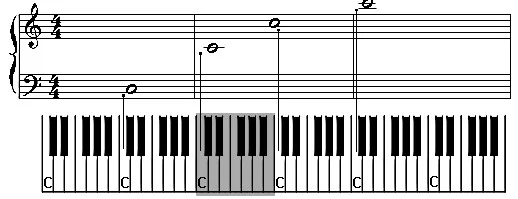
Unlike many other instruments, the piano has a huge tonal range. To put this on paper, we use the grand staff. It connects two staves together:
The Treble Clef (G Clef): It is usually found on the upper staff and is responsible for the right hand. It covers the middle and high tones.
The Bass Clef (F Clef): It is found on the lower staff and is responsible for the left hand. It covers the low bass tones.
The connection between the two is the famous "Middle C" (C4). It sits on a ledger line exactly between the two systems.
The Piano Note System: Natural Notes, Accidentals & Mnemonics
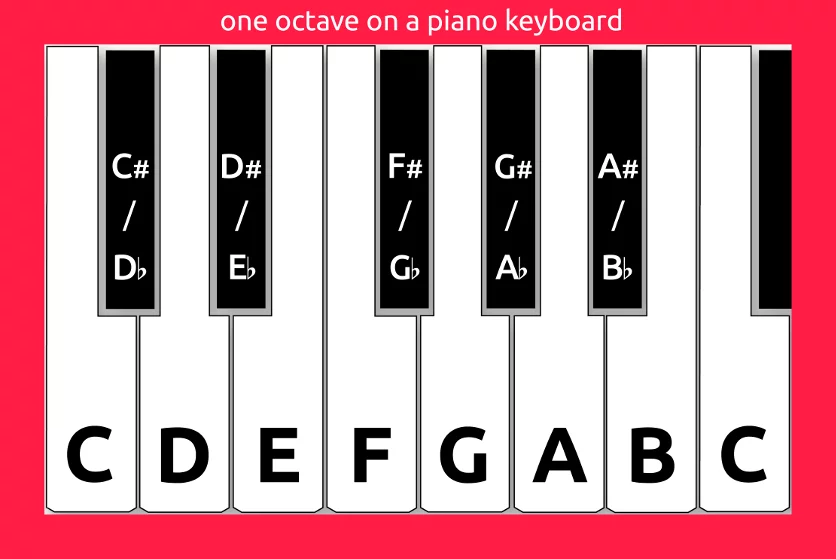
The fundamental tones, the natural notes, are named C, D, E, F, G, A, B. They repeat in different octaves. If the white keys (natural notes) aren’t enough, the black keys come into play. For this, we use accidentals (or sharps and flats) that indicate the direction on the keyboard:
Flat (♭) – To the left: This symbol lowers a note by one semitone. You slide to the nearest key on the left side (usually a black key). Example: E-flat (E♭) lies diagonally to the left of E.
Sharp (♯) – To the right: This symbol raises a note by one semitone. You move to the nearest key on the right side. Example: G-sharp (G♯) lies diagonally up to the right of G.
Natural (♮) – Back to standard: This cancels the effect of sharps or flats. You simply play the normal white key again.
At the start of learning notes, it helps enormously to memorise the tones with sayings until you recognise them automatically. Here are the most proven bridges for your memory.
Clef
Notes
Mnemonic
Treble Clef (Right Hand)
Notes on the lines (from bottom to top: E, G, B, D, F)
Every Good Boy Deserves Football
Treble Clef (Right Hand)
Notes in the spaces (F, A, C, E)
Spells the word: FACE
Bass Clef (Left Hand)
Notes on the lines (G, B, D, F, A):
Good Boys Deserve Football Always
Bass Clef (Left Hand)
Notes in the spaces (A, C, E, G):
All Cows Eat Grass
We have compiled the complete keyboard for you with detailed tones, octaves, and note positions on the staff in relation to all 88 keys. You can download the overview of the piano note system for free:
The Biggest Hurdle in Reading Sheet Music: Coordinating Both Hands
Many beginners report feeling like a "rabbit in the headlights" when suddenly both hands are supposed to do different things. That is completely normal!
Here are three golden rules to master this:
Practise separately: Always learn the right hand alone first, then the left hand alone. Only when both are secure do you bring them together.
Eyes on the sheet, not the hands: A common mistake is constantly looking at the keys. Try to keep your gaze on the sheet music. This trains your blind orientation on the keyboard enormously.
Slow is the new fast: If you stumble, you are too fast. Use a metronome or an app to drastically reduce the tempo.
Why Learning Sheet Music Digitally Is Worth Its Weight in Gold for Pianists
Of course, you can learn notes from books. But digital tools offer decisive advantages that not only speed up your learning process but also make it much more flexible:
Set your own pace: You aren’t tied to rigid appointments. You decide how fast you progress and can repeat lessons as often as you like until you feel confident.
Theory meets practice: Dry theory is often abstract and boring. With music2me, you learn a theoretical concept and apply it immediately in a real song. This mix of music theory and practice helps you internalise what you’ve learned straight away and keep the fun in playing.
Additional material: Want to practise offline at the piano sometimes? No problem. Professional sheet music and fingerings are available to print out for the lessons, so you stay flexible at all times.
Conclusion: Just Get Started!
Learning how to read sheet music for piano only seems like a huge mountain at the beginning. As soon as you’ve taken the first steps, you’ll notice how logical the system is—much more logical than with many other instruments.
Sit down at the piano—your musical journey begins now!
Frequently Asked Questions about Learning Piano Notes
Is reading sheet music harder for piano than for guitar?
Actually, it is even simpler because the system is very visual: If the note goes up in the system, you also move to the right (up) on the keyboard. Each note exists only once in that specific octave.
Do I really have to learn the bass clef?
Yes, for the piano it is essential, as the left hand is almost always notated in the bass clef. Many beginners neglect this, but we recommend learning it from the start.
How often should I practise to read notes fluently?
Frequency is more important than duration. Ten minutes a day achieve more than one hour once a week. Our brain needs repetition to store the patterns.
How long does it take until I can play two-handed from sheet music?
This depends heavily on your practice routine. With daily short sessions (10-15 minutes), you can often read and play simple pieces after just a few weeks.
Can I still learn notes as an adult?
Absolutely. Adults often benefit from their discipline and structured thinking. Many of our users in the 55-64 age group are successfully learning with our piano course.
Blues is the root of almost all modern music and has produced countless legendary tracks that became immortal on six strings and 88 keys. In this article, we present 10 unforgettable blues and blues‑rock songs every musician should know.
Anyone can learn piano – all you need is the right method, a bit of patience, and a love of music. This guide will take you through the most important basics, from the keyboard layout to note values, time signatures, and your first melodies and chords. With simple exercises and practical tips, you'll quickly see progress – perfect for beginners!