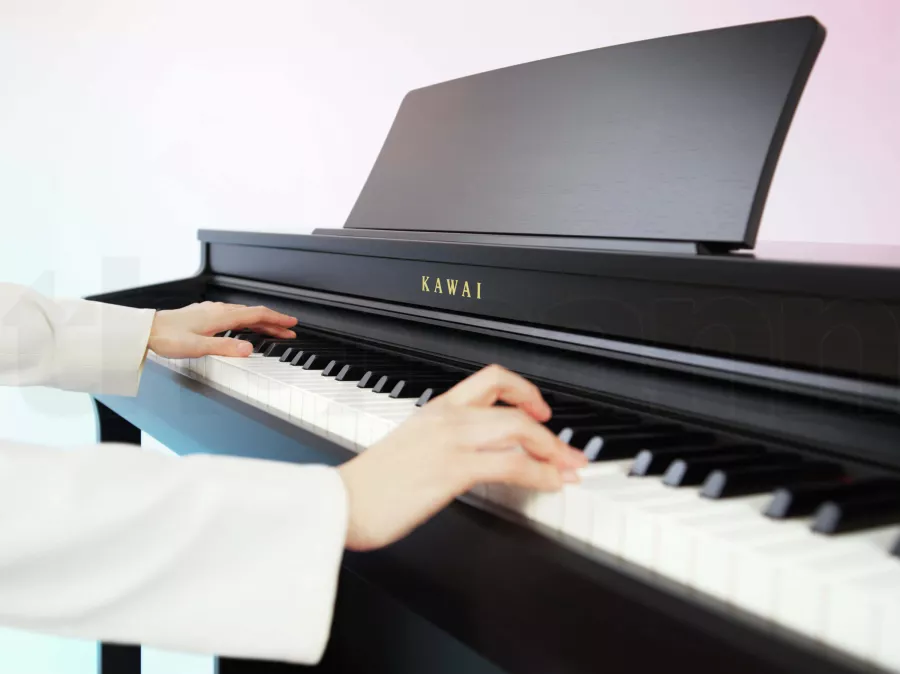
Are you looking for a digital piano that doesn’t feel like a compromise, but like a real instrument? Then the Kawai CN 201 is just right for you. As the successor to the popular CN 29, it has big shoes to fill.
In this Kawai CN 201 review, we’ll take a close look at whether the playing feel and sound are really as authentic as the first impression suggests. Is this instrument the right choice for learning piano? Let’s find out!
The Essentials of the Kawai CN 201 at a Glance
Basically: The Kawai CN 201 is a digital piano in the upper entry-level to mid-range class and the direct successor to the successful CN29 model.
Important: It scores points with the high-quality "Responsive Hammer III" keyboard, Ivory Touch surface, and let-off simulation for an authentic playing feel.
Tip: Definitely use the Bluetooth function to control sounds visually and to operate the "Virtual Technician" easily.
The First Impression: More Than Just Entry-Level?
As soon as you play the first notes, you notice: The Kawai CN 201 sounds and feels like a significantly more expensive piano. It feels very well-built and immediately offers a dynamic range that is simply fun to play. Fine gradations are possible here that will satisfy even ambitious players. We would describe it as a classic instrument for the upper entry-level.
Our Rating at a Glance:
 Pro Pro
|  Contra Contra
|
| |
| |
| |
| |
Want to experience the Kawai CN 201 yourself? You can find the instrument here at our trusted retailer:
The Keyboard: Grip and Precision Thanks to Ivory Touch
Kawai is a traditional piano manufacturer – and you can feel that immediately in the keyboard. Unlike cheaper models, the Ivory Touch coating is used here.
How does this benefit you?
Moisture-absorbent: Even if you tend to have sweaty hands, you always maintain a good grip.
Tactile feel: The surface isn't rough, but a real "pleasure to touch" – smooth, yet grippy.
Let-off simulation: The CN 201 features a 3-sensor system. You feel a slight resistance (pressure point), which makes triggering the tone during very quiet playing (pianissimo) extremely precise.
The Sound: Shigeru Kawai Concert Grand in Your Living Room
The heart of the sound is the sample of the Shigeru Kawai SK-EX Concert Grand. This is the best Kawai has to offer. In our Kawai CN 201 review, this sound impresses with enormous brilliance and depth. But that’s not all. Kawai offers real variation here:
SK-EX Concert Grand: Present in the mids, very transparent and finely balanced.
EX Concert Grand: Provides significantly more pressure in the bass and appears even brighter.
The difference between these two basic sounds is clearly audible and not just a marginal EQ change. This gives you flexibility for different pieces of music.
Classical & Dynamics Check
We tested the piano with the Diabelli Variations (Beethoven and Schubert) to check the dynamics.
The result: Everything from delicate pianissimo to powerful forte can be expressed wonderfully. You don’t need to switch specific sound presets to play quietly or loudly – the dynamics come purely from your fingers and the piano's technology.
Further Sounds
Besides the grands, there are of course Upright Pianos. Kawai has refrained from exaggerating the "honky-tonk" sound here. It sounds natural and is excellently suited for pop songs or pieces by Erik Satie. The E-Pianos (e.g., Fender Rhodes) and strings (String Ensemble) also sound absolutely top-notch and can be mixed wonderfully with the piano in Dual Mode.
Overall, the CN 201 comes very close to the feel and sound of an acoustic piano, which is impressive for a digital piano for beginners in this price range.
Connectivity & Apps: The Hidden Smart Pro Feature
Many reviews concentrate purely on keys and sound, but in everyday life, another feature is worth its weight in gold: Bluetooth Audio. While you often have to fiddle with AUX cables on older digital pianos, the Kawai CN 201 connects wirelessly to your tablet or smartphone. This means the piano functions as a high-quality Bluetooth speaker for your mobile device.
Why is this brilliant for apps like music2me?
Imagine this: You open a video lesson on your tablet. Instead of hearing the sound squeaking out of small tablet speakers, the voice of your piano teacher and the backing track come directly through the voluminous speakers (or your headphones) of the Kawai CN 201. The whole thing is mixed perfectly with your own piano playing. You have no cable clutter and an immersive "right in the middle" feeling, almost like in a real face-to-face lesson.
Learn piano with music2me!
Imagine sitting at the piano, your fingers gliding effortlessly across the keys as you play melodies that move your heart. With music2me, you can learn piano at your own pace – step by step with a system that truly helps you progress, whether you’re a beginner or already advanced.
Discover piano course now
Of course, there are also Kawai's own apps (PianoRemote & PiaBookPlayer) for adjusting sounds or displaying sheet music. But for daily practice, the ability to seamlessly and wirelessly integrate your learning app into the instrument is the real gamechanger.
Accessories Check: What You Really Need
The Kawai CN 201 is often offered as a set. But are the parts useful? Definitely – here are the two must-haves for getting started:
The Right Bench
Forget the kitchen chair. A height-adjustable piano bench is mandatory for healthy posture. Only then can you adjust the seating height exactly so that your forearms are level with the keys. This prevents back pain and is essential for clean technique.
Suitable Headphones
For silent practice, we recommend closed-back over-ear headphones. They shield you from the environment and bring out the high-quality piano sound to the fullest. Important: Look for a long cable (approx. 3 metres) so you have enough freedom of movement at the instrument and aren't "leashed".
Our Recommendation: A bundle saves you the search and ensures that you start correctly, both ergonomically and sonically. You can find the bundles available at Thomann here:
Is the Kawai CN 201 Worth the Money?
In summary, the Kawai CN 201 is an absolutely solid instrument. It brings everything you need in terms of technology: metronome, layer function, recording function, and modern Bluetooth features.
It is an absolute purchase recommendation for piano lessons. For beginners looking for a reliable starter digital piano as well as for ambitious hobby musicians, it offers a keyboard and sound quality that provide joy for a long time and do not hinder technical progress, but promote it. Anyone who enjoys playing the piano and values an authentic feel won't go wrong here. It is arguably one of the candidates for the best digital piano.
Technical Data at a Glance
Feature | Details |
Keyboard | Responsive Hammer III (RH3) with Ivory Touch & Let-off |
Sound Engine | Progressive Harmonic Imaging (SK-EX & EX Samples) |
Polyphony | 192 voices (sufficient for complex pieces) |
Speakers | 2 x 12 cm (2 x 20 Watt output) |
Display | High-resolution OLED Display (128 x 128 Pixels) |
Weight | 43 kg |
Dimensions (W x D x H) | 136 x 40.5 x 86 cm |
Connections | 2x Headphones output, USB to Host, Bluetooth (Audio & MIDI) |
FAQ: Frequently Asked Questions about the Kawai CN 201
What is the difference between the Kawai CN 201 and its predecessor, the CN 29?
The CN 201 offers an improved speaker system for clearer sound, optimised noise damping of the keyboard, and new Bluetooth Audio functionalities.
Do I need external speakers for the Kawai CN 201?
No, the internal speaker system is completely sufficient for living rooms and practice rooms and delivers a full sound.
Can I practice at night with the Kawai CN 201?
Yes, the piano features two headphone jacks. Thanks to the "Spatial Headphone Sound" technology (SHS), it sounds very spatial even through headphones and fatigues the ears less.
Is the piano available in different colours?
Yes, the Kawai CN 201 is usually available in Satin Black, Satin White, and Rosewood.
Is the keyboard heavy to play?
The "Responsive Hammer III" keyboard is weighted to simulate a real piano. It isn't "heavy" in a negative sense, but offers the necessary resistance for expressive playing, similar to an acoustic grand piano.