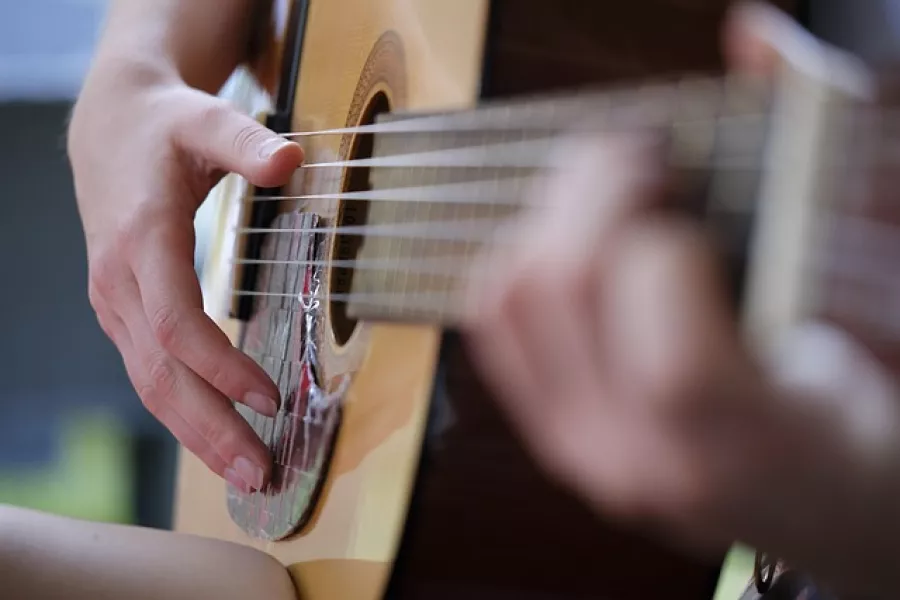
Whether you’re just starting out on the guitar or are already an advanced player: finger exercises are among the most important foundations for clean and controlled guitar playing. They train the dexterity of your fingers, strengthen the coordination between your left and right hand, and help you play faster and more precisely.
Many guitarists want to learn songs as quickly as possible and underestimate the importance of technical exercises in the process. But this is often exactly where the key to cleanly played chords, fast solos, and a relaxed playing feel lies. Regular practice ensures that your fingers work more independently and that movements become automated. The best part: you don't need complicated music theory or hours of practice sessions to do them. Just a few minutes a day are enough to make huge progress in the long run.
The Essentials of Finger Exercises for Guitar at a Glance
Basically: Targeted finger exercises for guitar improve the dexterity, independence, and coordination of both hands, forming the foundation for fluid playing.
Important:Slow, clean, and controlled playing is much more crucial at the beginning than a fast tempo, in order to avoid learning incorrect movements.
Tip:Use a metronome for your exercises right from the start to sustainably strengthen not only your finger technique but also your sense of rhythm and timing.
The Right Preparation: Posture and Technique
Before you start with the exercises, you should ensure you have a proper posture with your guitar. Incorrect movements can quickly creep in and be difficult to correct later on.
Left-Hand Posture
Your fretting hand should always remain relaxed to prevent cramps. Pay attention to the following points:
The thumb rests loosely and roughly in the middle of the back of the guitar neck.
The fingers press on the strings as vertically as possible.
Each finger moves independently and stays close to the fretboard.
Small, efficient movements save a huge amount of energy and increase your accuracy.
Right-Hand Posture
The picking hand also needs to work loosely and dynamically:
The wrist remains relaxed and flexible.
The movement impulses are small and controlled.
When alternate picking, downstrokes and upstrokes alternate evenly.
It's best to use a metronome for stable timing and controled tempo.
Technique Exercise Without a Guitar: The 4-Finger Pattern
A simple but highly effective technique exercise for guitarists is the so-called tapping in the four-finger pattern. Here, you specifically train the independence and control of your fingers – entirely without a guitar or with a minimal setup.
Rest your fretting hand loosely on a tabletop, your thigh, or directly on the guitar fretboard. It's important that the hand remains relaxed and no unnecessary tension builds up. Now, tap your fingers on the surface one after the other in a controlled manner:
1 = Index finger
2 = Middle finger
3 = Ring finger
4 = Little finger
Make strictly sure that only the finger whose turn it is does the work. The other fingers remain resting and relaxed. The ring finger and the little finger, in particular, tend to move unintentionally at the beginning. Start slowly and focus entirely on clean, controlled movements. Speed doesn't matter at first. What's more important is that you only lift your fingers minimally. Small movements are more efficient and lead to more precision and less tension when playing in the long run.
Once you've got the movement down safely, you can add a metronome. This will additionally improve your timing and help you develop a steady sense of rhythm. For more variety and a stronger training effect, you can try out different sequences, for example:
1-3-2-4
4-3-2-1
1-4-2-3
Make sure your hand, forearm, and shoulders stay relaxed throughout the entire exercise. Just a few minutes a day are enough to noticeably improve your finger independence and control.
Chromatic Finger Exercise Across the Fretboard
Chromatic exercises are among the most effective basic exercises for guitarists and train finger independence and consistency. In doing so, you play all four fingers one after the other on different frets.
The Classic 1-2-3-4 Exercise
Start on the low E string.
Fret the 1st fret with your index finger, the 2nd fret with your middle finger, the 3rd fret with your ring finger, and the 4th fret with your little finger.
Play this sequence (1-2-3-4) and then switch to the next highest A string, then the D string, etc.
Once you've reached the high E string, slide your whole hand one fret further up (starting on the 2nd fret) and play the pattern backwards back across the strings.
Make sure you consistently maintain alternate picking (alternating downstrokes and upstrokes) in your right hand. Every note must sound clear and without any buzzing.
More Variations for an Extra Challenge
As soon as you can confidently play the basic exercise, you can try out new finger combinations. These variations challenge your finger coordination much more and train all your fingers:
1-2-4-3
1-3-2-4
1-3-4-2
1-4-2-3
1-4-3-2
Picking Exercises for the Right Hand
It's not just the fretting hand that needs training. The picking hand also dictates timing, dynamics, and precision. Alternate picking is particularly important here. With alternate picking, downstrokes (plectrum downwards) and upstrokes (plectrum upwards) alternate continuously. This ensures much more fluid playing, greater speed, and an even tone.
Simple alternate picking exercise: First, just play on one open string (e.g. the low E string) constantly: downstroke, upstroke, downstroke, upstroke. Be sure to use a metronome for this. Start comfortably at 60 BPM. Only increase the tempo gradually when everything truly sounds clean.
Learn guitar with music2me!
Do you dream of playing your favourite songs around the campfire or rocking out to the riffs of your heroes? With music2me, you can learn guitar at your own pace – step by step with a system that truly helps you progress, whether you’re a beginner or already advanced.
Over 400 video lessons & downloadable sheet music
Interactive features like our smart practice mode and gamification
Once both hands are working individually, it's time for synchronisation. This is often where you'll see if exercises are really being played in a controlled manner. This type of exercise forms the foundation for fast riffs, solos, and fluid melody playing.
Play the classic chromatic 1-2-3-4 exercise with continuous alternate picking. Pay attention to the following:
Every pick occurs exactly as the note is fretted.
Neither hand is faster than the other.
All notes sound equally loud.
The Spider Exercise
The so-called "spider" is one of the most effective finger exercises for guitarists when it comes to finger independence, coordination, and control on the fretboard. The unusual finger combinations specifically train the movement of the fretting hand. The exercise seems simple at first but challenges the fingers significantly more than classic chromatic sequences. The main focus here is on controlling the individual finger pairs and making slow, steady movements.
How the Exercise Works:
Place your middle finger on the A string (5th fret) and your little finger on the B string (7th fret) at the same time.
Now the index finger frets one fret further up on the A string (6th fret). At the same time, the ring finger frets one fret further up on the B string (8th fret).
Then the pattern is reversed: the little finger goes to the A string on the 7th fret, and the middle finger goes to the B string on the 5th fret.
Then you switch: ring finger to the A string (6th fret), little finger to the B string (4th fret).
The goal is to execute all movements as controllably and evenly as possible, without any uninvolved fingers lifting off the fretboard. This exercise works wonders for difficult open chords!
Why This Exercise Is So Effective
Thanks to the staggered movements, you specifically train the independence of your fingers. The unfamiliar combination of moving the middle and little finger to the ring and index finger, in particular, improves your control on the fretboard in the long run.
Additionally, the exercise trains your fretting precision and synchronisation with your picking hand. Every note should sound clean, even, and controlled. This exercise is also best played with a simple fingerpicking pattern. This type of technique training is enormously helpful, especially for open chords and more demanding chord changes.
Short Melodies as a Practical Application
Technical exercises become much more motivating and musical when you translate them directly into short melodies. This way, you combine finger training with a real playing feel and realise more quickly how the technique feels in actual songs.
A very good example of this is the famous theme from "In the Hall of the Mountain King" from Edvard Grieg's Peer Gynt Suite. The striking, step-by-step ascending melody is wonderfully suited for training simple finger movements and clean timing. At the same time, you can easily combine the melody with alternate picking in your right hand to synchronise both hands.
Spiele die Hauptfigur zunächst langsam und konzentriere dich auf saubere Übergänge zwischen den Tönen. Wenn du das Thema sauber beherrschst, kannst du es schrittweise beschleunigen oder in verschiedenen Lagen auf dem Griffbrett spielen. So wird aus einer einfachen Melodie eine effektive Übung für Präzision, Timing und musikalisches Ausdrucksgefühl.
Tips for Practising
Start the exercise very slowly and initially concentrate solely on clean movements. Speed is secondary at the beginning.
Make sure your fingers stay as close to the fretboard as possible. Small movements save energy and ensure greater precision when playing later on.
Once the movements are working confidently, you can play the exercise with a metronome and increase the tempo step by step.
The most important thing always remains: control over speed. The "spider" reveals its greatest effect when every movement is executed consciously and cleanly.
How Long Should You Do Finger Exercises for Guitar?
Many guitarists believe they have to train their technique for hours. In fact, short, regular sessions often achieve much more.
Focus is more important than duration. It's better to practise slowly and in a controlled manner rather than quickly and inaccurately.
Recommended Practice Duration:
For beginners: 10–15 minutes daily
For advanced players: 20–30 minutes of targeted technique training
Common Mistakes & the Best Tips for Your Finger Training
To make your practice time as effective as possible, you should avoid these classic pitfalls and heed our advice:
Too Much Speed & Impatience Always start your exercises (whether it's picking, synchronisation, or melodies) very slowly – ideally with a metronome at around 60 BPM. Only increase the tempo once the movements are absolutely fluid and flawless.
"Flying Fingers" (Lack of Control) During the four-finger pattern and the "spider", be strictly sure that only the finger whose turn it is does the work. The remaining, uninvolved fingers must stay relaxed. They shouldn't unconsciously move along or lift far off the fretboard (small movements save energy!).
Unclean Tone & Lack of Synchronisation Every note must sound crystal clear without buzzing. During synchronisation exercises, pay meticulous attention to ensuring that the right-hand pick occurs exactly at the same time as the left-hand fretting. Neither hand should be faster than the other, and all notes should sound equally loud.
Tense PosturePain or severe tension in your hand are absolute warning signs! If your hands cramp up, shake them out. Always ensure you have loose shoulders, relaxed wrists, and calm, steady breathing.
Small Steps to Noticeable Guitar Success
Finger exercises sometimes seem monotonous in the daily grind, but they are by far the most effective method for sustainably taking your guitar technique to the next level. They promote dexterity, finger independence, precision, and timing. Even experienced pros use chromatic exercises, alternate picking, or the "spider" as a daily warm-up. Always remember: slow, clean playing brings much more in the long run than frantic speed training. Incorporate these exercises into your routine for 10 to 15 minutes daily, and you'll be amazed at how easy chords and solos become after just a short time!
FAQs About Finger Exercises for Guitar
Why do my hands cramp up during finger exercises on the guitar?
This is often due to playing at too fast a tempo or using too much force when pressing down the strings. Consciously play the exercises more slowly and actively pay attention to maintaining a relaxed body and hand posture.
What should I do if my fingertips hurt while practising?
This is completely normal for beginners, as protective calluses still need to form on the fingertips. If the skin burns, don't force anything and take a short break. Important: it's best not to practise right after showering or washing the dishes, as softened skin tears much more quickly on the strings.
Is it normal for my little finger to be much weaker during the exercises?
Yes, this is absolutely typical and no cause for concern! The ring finger and the little finger partially share the same tendons and are used in isolation much less frequently in our everyday lives. That’s exactly why they often feel immobile at first. Exercises like the four-finger pattern or the "spider" target this precisely and build up the missing strength and independence step by step.
Should I do finger exercises before or after playing the guitar?
It's best to use them directly as a warm-up before you actually play. This optimally prepares your tendons, muscles, and joints for the strain, promotes blood circulation, and makes you much more motorically focused when you practice your songs or difficult chords afterwards.
Is there a difference between finger exercises for electric guitar and acoustic guitar?
The basic finger exercises – such as the chromatic runs – are identical on both types of guitar. The difference lies in the effort required: on the acoustic guitar (especially on steel-string acoustics), you initially need a bit more finger strength to fret the notes. On the electric guitar, on the other hand, the strings respond more easily; in return, you have to pay more attention to cleanly muting uninvolved strings to avoid unwanted background noise.
Want to learn guitar but don't know where to start? This guide walks you through the first essential steps — perfect for beginners who want to make quick progress.
You'll receive valuable insights on choosing the right guitar, proper playing and posture techniques, and how to read music and tablature. You'll also learn how to play chords, take care of your guitar, and discover the secrets of effective practice to continuously improve your playing. Let's get started!
You want to learn to play the guitar but are unsure which type of lessons suits you – and what the whole thing might cost? In this article, you'll find a comprehensive overview of the various forms of guitar lessons: from music schools and private lessons to online courses. We’ll show you what prices to expect, what factors influence the cost, and how you can learn guitar even on a tight budget.
You want to learn electric guitar and don't know exactly where to start? Don't worry – the beginning is easier than you think. In this guide, we'll show you how to master your first songs with the right equipment, a structured learning plan, and lots of fun in 5 clear and simple steps.
Whether you love rock, pop, metal, or blues, the electric guitar offers you all kinds of sound possibilities. Let’s get started!