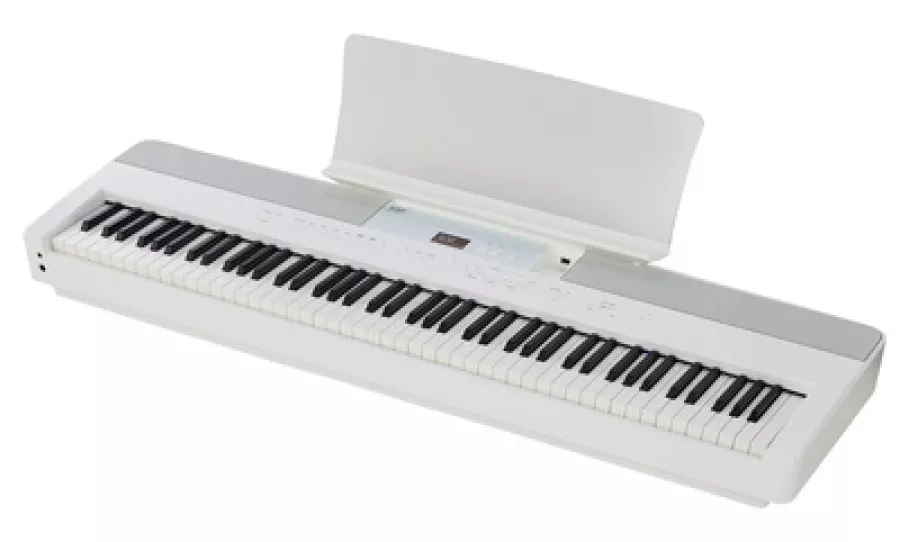
Are you looking for a digital piano that combines excellent sound with an authentic playing feel yet is light enough to transport? As the “big brother” to the popular entry-level Kawai ES-120, the ES-520 fills an important gap in Kawai’s lineup.
In our comprehensive Kawai ES 520 review, we take a close look at this popular portable piano to see if the instrument is the right choice for both ambitious beginners and advanced players.
The Essentials of the Kawai ES-520 at a Glance
Basically: The Kawai ES-520 is a versatile portable piano that combines the benefits of a stage piano (low weight) with the features of a classic home piano.
Important: It features a high-quality RH-C (Responsive Hammer Compact) keyboard with an Ivory Touch surface, offering you a secure hold and optimal grip even during longer practice sessions.
Top Tip: Thanks to the built-in Bluetooth audio function, you can use the piano like a stereo system, streaming backing tracks or online lessons straight from your smartphone through the powerful speakers.
If you’re just starting to learn the piano, you need an instrument you’ll enjoy sitting at every day. It should be ready to play straight away without much fuss and motivate you with a great sound. This is exactly where the Kawai ES-520 comes in.
Pros and Cons of the Kawai ES 520 at a Glance
 Pros Pros
|  Cons Cons
|
Very good playing feel (RH-C keyboard with Ivory Touch) | The key resistance might be slightly too light for classical purists |
Dynamic, well-rounded piano sound | Fewer sound options compared to dedicated synthesisers or workstations |
Practical Bluetooth audio | |
Two headphone jacks (mini and standard) | |
Compact and portable (ideal for travelling) | |
Want to experience the Kawai ES 520 for yourself? You can find the instrument at our trusted retailer here:
The Keyboard: How Does the Kawai ES-520 Play?
The heart of any piano is its keyboard. In the ES-520, Kawai has installed the so-called RH-C (Responsive Hammer Compact) keyboard. This is Kawai’s proven entry-level keyboard, which, despite its compact design, is equipped with a genuine hammer action.
In practical testing, the keyboard feels very pleasant and well-balanced. A big plus is the Ivory Touch surface (ivory simulation). This slightly textured coating ensures you don’t slip, even if you work up a sweat during long practice sessions or gigs.
The keys are comfortably responsive – a massive advantage for beginners who don’t yet have the finger stamina for very heavy actions but are still looking for an authentic playing feel.
Sound and Speakers: From Classical to Jazz
The keyboard isn't everything, of course – the sound generation plays just as big a role in a digital piano. And this is where the Kawai ES-520 truly delivers.
Pianos and Fine Dynamics
"Piano 1" – the versatile flagship sound of the instrument – sounds outstanding. We tested the piano with classical pieces (by Beethoven and Schubert, among others). The ES-520 responds fantastically to dynamics. Quiet, soulful passages can be executed just as precisely as loud, powerful accents (crescendos).
With many digital pianos in this price range, you often have to manually select a softer piano sound for gentle sections. The ES-520 provides this level of expression right out of the box in its default sound.
Electric Pianos, Strings, and Layering
Alongside the classic grand piano sound, the piano offers a tasteful selection of additional sounds:
Electric Pianos: Impressive, with fantastic built-in tremolo effects.
Organs and Harpsichord: Solid and highly versatile.
Strings: The dynamics of the keyboard score points here again. The strings can be beautifully nuanced and don't just blast at full volume at the slightest touch of a key.
The so-called layering (stacking sounds on top of each other) is particularly fun. If you simply press two sound buttons at the same time – for instance, piano and strings – you instantly create a broad, cinematic wall of sound.
Powerful Speakers
You shouldn't forget: This is a portable piano. You can unscrew it from the optional wooden stand, tuck it under your arm, and easily take it to your next choir rehearsal or gig. Despite the compact design, the built-in speakers are a real surprise. They sound voluminous, clear, and have more than enough power to effortlessly fill a medium-sized living room or a rehearsal space.
Smart Features for Beginners and Professionals
The Kawai ES-520 is refreshingly self-explanatory and straightforward to operate. It offers all the features you need for modern piano lessons and daily practice:
Split Function: Divide the keyboard into different sound zones.
Transpose: Change the pitch at the touch of a button if a backing track is in a tricky key.
Metronome and Recorder: Perfect for staying in time and quickly recording your own ideas.
Effects: Amp simulation and reverb are already on board.
A small but brilliant detail: On this piano, you won't just find the standard 6.3 mm jack socket, but also a mini-jack socket (3.5 mm) for headphones. The constant search for an adapter is finally a thing of the past!
Why Is This Brilliant for Learning Apps Like music2me?
The ES-520 features Bluetooth audio. This is an absolute game-changer for modern piano students. You can connect your smartphone wirelessly and stream audio signals straight to the piano's speakers. This brings massive benefits to your practice routine: The sound from practice videos, backing tracks, or online lessons from the music2me app no longer sounds tinny from your phone, but rich and full through the built-in piano speakers. You’ll feel as though you're playing along with a proper hi-fi system!
Learn piano with music2me!
Imagine sitting at the piano, your fingers gliding effortlessly across the keys as you play melodies that move your heart. With music2me, you can learn piano at your own pace – step by step with a system that truly helps you progress, whether you’re a beginner or already advanced.
Over 400 video lessons & downloadable sheet music
Interactive tools like Skill Check & smart practice mode
Weekly live classes & personal teacher support
Exclusive Discord community for motivation & exchange
Discover piano course now
Useful Accessories: What Else Do You Need for the Kawai ES-520?
Since the ES-520 is designed as a portable piano, you can adapt it for your home setup or the stage. If you want to start perfectly equipped right away, it's worth taking a look at complete sets like the Kawai ES-520 B Deluxe Bundle. This already includes everything we recommend as the ideal addition:
Digital Piano Stand: To transform the ES-520 into a full-fledged, modern digital piano for your home, the matching Kawai HM-5 B wooden stand is highly recommended.
Pedal Unit: The 3-pedal unit Kawai F-302 B, which is included in the bundle and integrates perfectly into the wooden stand, ensures an authentic piano feel and caters to advanced playing.
Piano Stool: A comfortable, height-adjustable seat ensures a healthy and relaxed posture while practising.
Good Headphones: One of the biggest advantages of a digital piano is silent practice. Use the handy headphone jack to play entirely undisturbed and in top sound quality with closed, over-ear headphones.
Conclusion: Who Is the Kawai ES-520 Suitable For?
The Kawai ES-520 comes highly recommended – for beginners and advanced players alike. It offers an excellent blend of home piano and stage piano. Considering its price bracket, you get an extremely grippy keyboard, a great design, and sounds that are genuinely fun to play. Anyone looking for a thoroughly well-thought-out digital piano for piano lessons, practising at home, or occasional gigs can’t go wrong with the Kawai ES-520.
Technical Specifications at a Glance
Feature | Specification |
Keyboard | RH-C (Responsive Hammer Compact) with Ivory Touch |
Sound Generation | Progressive Harmonic Imaging™ (PHI), 88-key sampling |
Polyphony | Max. 192 voices |
Speakers | 2 x 20 watts (developed with Onkyo) |
Display | 128 x 64 pixel OLED |
Weight | 14.5 kg |
Dimensions (W x D x H) | 134.0 x 37.5 x 14.5 cm |
Frequently Asked Questions About the Kawai ES-520
Is the Kawai ES-520 Suitable for Beginners?
Absolutely! The built-in RH-C keyboard is light enough not to tire untrained fingers during practice, yet it offers a realistic playing feel thanks to the genuine hammer action. This means you learn the correct technique right from the start, which you'll continue to benefit from as an advanced player.
How Does the Kawai ES-520 Differ From the More Compact ES-120?
The Kawai ES-120 is an outstanding, lightweight entry-level model, but it offers a lower speaker output (2x 10 watts) and fewer instrument sounds. The ES-520 strikes the perfect balance here, scoring points with significantly more powerful speakers (2x 20 watts), a more extensive sound selection, and a practical OLED display. So, if you're looking for greater tonal depth and a higher level of usability for your musical development right from the start, the ES-520 is the better choice.
Can I Also Make Recordings With the Kawai ES-520?
Yes, the ES-520 features a built-in recorder that allows you to easily record your own playing directly on the instrument. This isn't just ideal for capturing spontaneous musical ideas, but it also helps you enormously with self-monitoring while practising, so you can hear your progress objectively.
Can I Also Use the Kawai ES-520 for Gigs?
Definitely! It's designed as a true portable piano and weighs just 14.5 kg without the optional wooden stand. You can simply unscrew it from the frame and easily transport it in the car to band rehearsals, choir performances, or gigs. Thanks to its robust build, it handles regular transport perfectly well.
What Is the Best Way to Care for the Ivory Touch Keyboard?
The textured ivory simulation is very straightforward to clean in everyday use. The best thing to do is simply wipe the keys with a soft, dry microfibre cloth after playing. For light dirt, a barely damp cloth (with water only) will do the trick – however, make sure you avoid aggressive cleaning agents so as not to damage the high-quality coating.